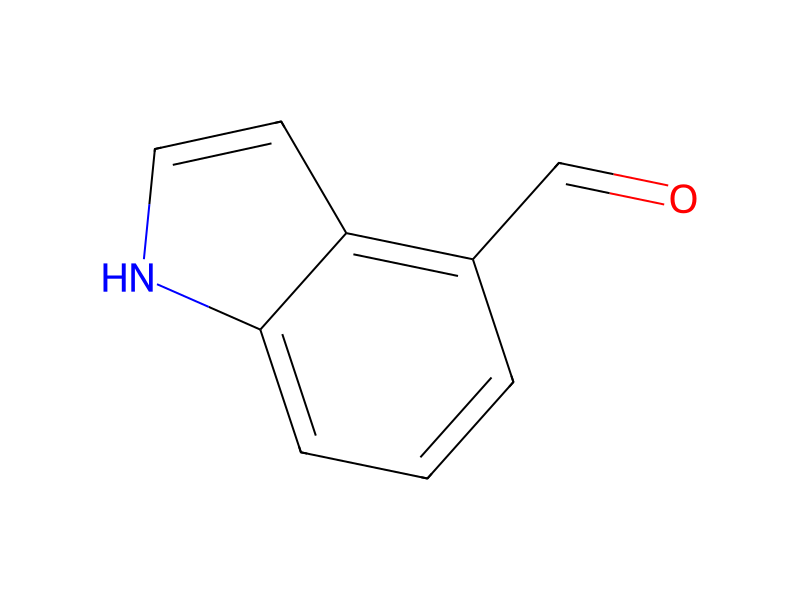
Methyl iodide → 1-Methyl-1H-indole-4-carbaldehyde
Reaction equation

[NH:1]1[C:9]2[CH:8]=[CH:7][CH:6]=[C:5]([CH:10]=[O:11])[C:4]=2[CH:3]=[CH:2]1.[CH3:12]I>C(Cl)Cl.S([O-])(O)(=O)=O.C([N+](CCCC)(CCCC)CCCC)CCC.[OH-].[Na+]>[CH3:12][N:1]1[C:9]2[CH:8]=[CH:7][CH:6]=[C:5]([CH:10]=[O:11])[C:4]=2[CH:3]=[CH:2]1Participants
6





Procedure
34 g of indol 4-carboxaldehyde in 800 ml of methylene chloride were mixed for 4 hours at ambient temperature with 79.5 g of tetrabutyl ammonium hydrogen sulfate and 16.04 ml of methyl iodide in 400 ml of 5N sodium hydroxide and 300 ml of methylene chloride were added, followed by decanting and extraction was effected with methylene chloride. The organic phase was washed with a saturated aqueous solution of sodium chloride, dried and concentrated to dryness. Tho residue was chromatographed on silica (eluant: methylene chloride) to obtain 36.8 g of the expected product melting at <40° C.
Workup
- additionwere added
- customby decanting
- extractionextraction
- washThe organic phase was washed with a saturated aqueous solution of sodium chloride
- customdried
- concentrationconcentrated to dryness
- customTho residue was chromatographed on silica (eluant: methylene chloride)
Sources & evidence
- ORD record
- ord-5961bcb3bdb545d7b19e4cd78071c3b7
- Source dataset
- uspto-grants-1993_01
- Patent number
- US05182282
Reaction notes
Loading…