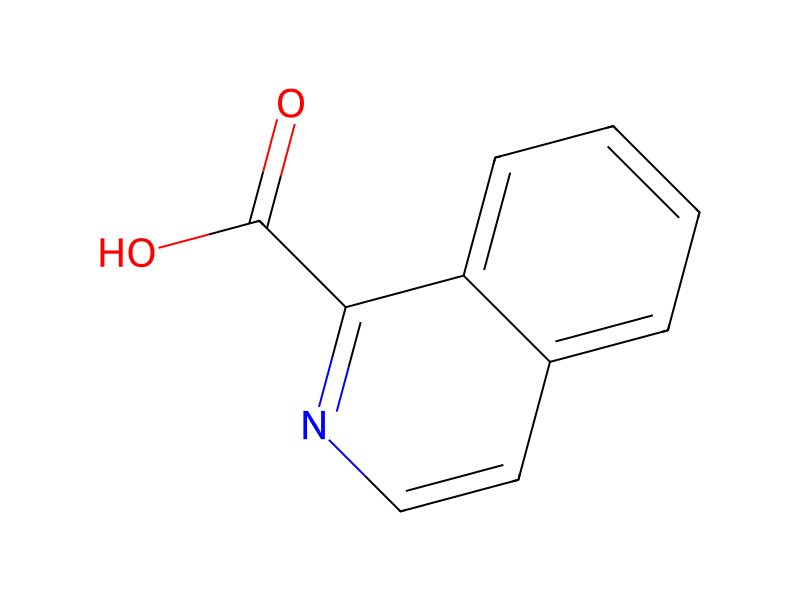
Isoquinoline-1-carboxylic acid → 1,2,3,4-Tetrahydroisoquinoline carboxylic acid
Reaction equation

[C:1]1([C:11]([OH:13])=[O:12])[C:10]2[C:5](=[CH:6][CH:7]=[CH:8][CH:9]=2)[CH:4]=[CH:3][N:2]=1.[H][H]>C(O)(=O)C.[Pt]=O>[CH:1]1([C:11]([OH:13])=[O:12])[C:10]2[C:5](=[CH:6][CH:7]=[CH:8][CH:9]=2)[CH2:4][CH2:3][NH:2]1Participants
5




Procedure
To a solution of isoquinoline-1-carboxylic acid (12.5, 0.072 mole) in 185 ml of glacial acetic acid was added 2 g of platinum oxide and the suspension was hydrogenated at room temperature under 60 psi hydrogen pressure in a Parr hydrogenation apparatus for 24 h. The reaction mixture was filtered though a filter pad (Celite) to remove the catalyst and the filtrate was evaporated to dryness in vacuo. The solid residue was triturated with water, filtered and dried to yield 8 g (63% yield) of DL-1,2,3,4-tetrahydroisoquinolin-1-carboxylic acid. FD-Mass spectrum 178 (MH+);
Workup
- filtrationThe reaction mixture was filtered though a filter pad (Celite)
- customto remove the catalyst
- customthe filtrate was evaporated to dryness in vacuo
- customThe solid residue was triturated with water
- filtrationfiltered
- customdried
Sources & evidence
- ORD record
- ord-bbcdcf3d808f4444a15c75bfd59a60de
- Source dataset
- uspto-grants-1995_07
- Patent number
- US05430023
Reaction notes
Loading…