Acrylic Acid → 3-(5-Fluoro-1H-indol-3-yl)propanoic acid
Reaction equation

[F:1][C:2]1[CH:3]=[C:4]2[C:8](=[CH:9][CH:10]=1)[NH:7][CH:6]=[CH:5]2.[C:11]([OH:15])(=[O:14])[CH:12]=[CH2:13].C(OC(=O)C)(=O)C>C(O)(=O)C>[F:1][C:2]1[CH:3]=[C:4]2[C:8](=[CH:9][CH:10]=1)[NH:7][CH:6]=[C:5]2[CH2:13][CH2:12][C:11]([OH:15])=[O:14]Participants
Reactant 3


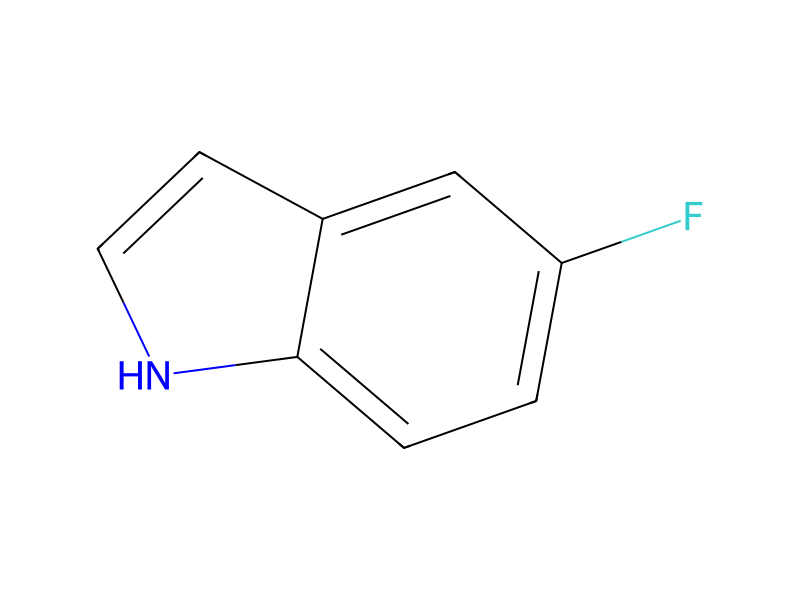
Product 1

Reagents, catalysts & solvents 1

Conditions
- Temperature
- 90 °C
Procedure
Thus, a solution of 5-fluoroindole (1.35 g, 0.010 mol) in 10 mL of acetic acid containing acrylic acid (1.5 mL, 0,022 mol) and acetic anhydride (1.9 mL, 0.02 mol) was heated (oil bath) at 90° C. under Ar for 5 days. The volatiles were then removed in vacuo and the residue was taken up in 3N NaOH. Insoluble material was removed by filtration and the filtrate was acidified with conc. HCl and then extracted with CH2Cl2. The organic extract was dried (Na2SO4) and evaporated to give the product (1.191 g, 57%) as a solid which was used without further purification: IR (neat) 3420, 1710 cm-1 ; 1Hnmr (200 MHz, CDCl3) δ 7.94 (br s, 1H), 7.28-7.18 (m, 3H), 7.05 (d, J=2.5 Hz, 1H), 6.93 (dt, J=9.0, 2.6 Hz, 1H), 3.05 (t, J=7.5 Hz, 2H), 2.73 (t, J=7.6 Hz, 2H).
Workup
- customThe volatiles were then removed in vacuo
- customInsoluble material was removed by filtration
- extractionextracted with CH2Cl2
- extractionThe organic extract
- dry with materialwas dried (Na2SO4)
- customevaporated
Sources & evidence
- ORD record
- ord-f9b1a426b4c749e1b99ee01f66ae805d
- Source dataset
- uspto-grants-1995_07
- Patent number
- US05434154
Reaction notes
Loading…