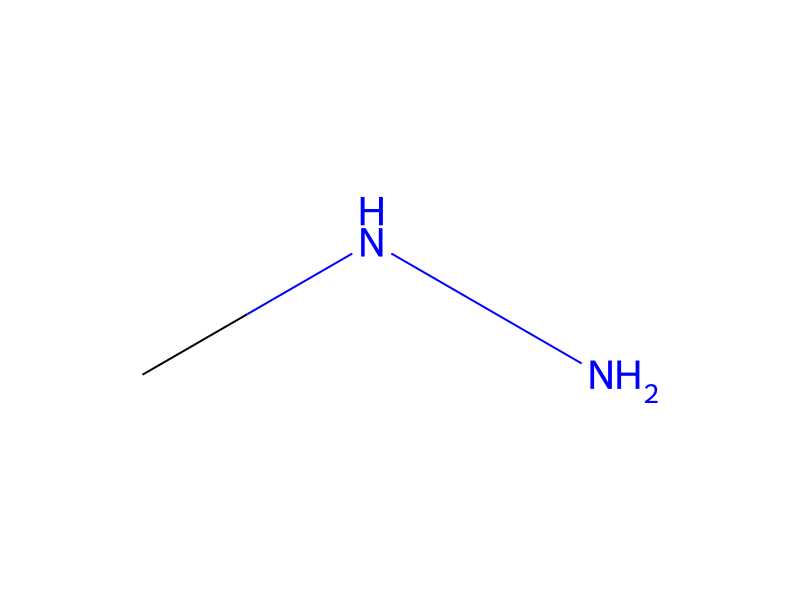
Methylhydrazine → Propyl 1-methylhydrazine-1-carboxylate
Reaction equation

[CH3:1][NH:2][NH2:3].[CH2:4]([O:7][C:8](=[O:13])[O:9]CCC)[CH2:5][CH3:6]>>[CH3:1][N:2]([C:8]([O:7][CH2:4][CH2:5][CH3:6])=[O:9])[NH2:3].[CH3:1][NH:2][NH:3][C:8]([O:7][CH2:4][CH2:5][CH3:6])=[O:13]Participants
4


Procedure
Methylhydrazine (7.2 g, 0.16 mole) and di-n-propylcarbonate (5 g, 0.034 mole) were stirred at room temperature for 96 hours to yield 1-methyl-1-propoxycarbonyl hydrazine and 2-methyl-1-propoxycarbonyl hydrazine in approximately equal amounts. The reaction was concentrated in vacuo and fractionated (F1, 2.0 g, 72°-76° a/0.8 mm Hg; F2, 1.1 g, 76°-88° a/0.8 mm Hg; F3, 1.1 g, 88°-90° a/0.8 mm Hg). F1 was a mixture of 1-methyl-1-propoxycarbonyl hydrazine and 2-methyl-1-propoxycarbonyl hydrazine in 4 to 1 ratio. F2 was an equal mixture of 1-methyl-1-propoxycarbonyl hydrazine and 2-methyl-1-propoxycarbonyl hydrazine. F3 was mostly 2-methyl-1-propoxycarbonyl hydrazine. Thus the yield of 1-methyl-1-propoxycarbonyl hydrazine was ca. 46%.
Sources & evidence
- ORD record
- ord-26b5950accff4e278aac9eea3fac4a78
- Source dataset
- uspto-grants-1983_11
- Patent number
- US04418076
Reaction notes
Loading…