Boron trifluoride etherate → Diethyl-4-(mercaptomethyl)-1,3-dithiolane-2,2-dipropanoate
Reaction equation

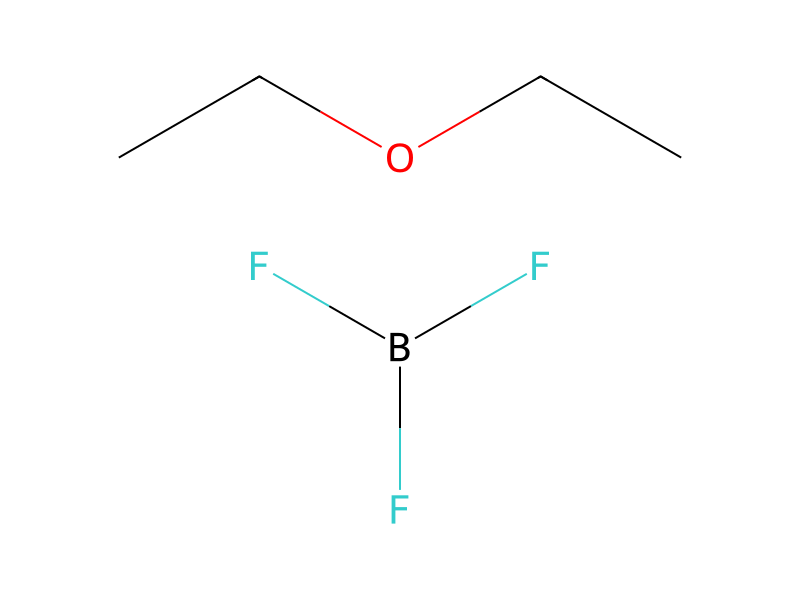
[SH:1][CH2:2][CH:3]([SH:6])[CH2:4][SH:5].O=[C:8]([CH2:16][CH2:17][C:18]([O:20][CH2:21][CH3:22])=[O:19])[CH2:9][CH2:10][C:11]([O:13][CH2:14][CH3:15])=[O:12].B(F)(F)F.CCOCC>C(Cl)Cl>[CH2:14]([O:13][C:11](=[O:12])[CH2:10][CH2:9][C:8]1([CH2:16][CH2:17][C:18]([O:20][CH2:21][CH3:22])=[O:19])[S:6][CH:3]([CH2:4][SH:5])[CH2:2][S:1]1)[CH3:15]Participants
5



Procedure
A stirred solution of 1,2,3-trimercaptopropane (10.0 g, 0.071 mol) and diethyl 4-oxopimelate (16.43 g, 0.071 mol) in methylene chloride (300 ml) under nitrogen atmosphere was treated with boron trifluoride etherate (2 ml). After stirring for 3 days at room temperature, the reaction was quenched by addition of 200 ml of 5% sodium bicarbonate solution. The organic phase was separated and dried over anhydrous sodium sulfate. The drying agent was filtered and the filtrate concentrated on the rotary evaporator. The residue was chromatographed on silica gel using 5% ethyl acetate/hexane as eluent to give 10 g (40%) of the title compound as an oil.
Workup
- customthe reaction was quenched by addition of 200 ml of 5% sodium bicarbonate solution
- customThe organic phase was separated
- dry with materialdried over anhydrous sodium sulfate
- filtrationThe drying agent was filtered
- concentrationthe filtrate concentrated on the rotary evaporator
- customThe residue was chromatographed on silica gel using 5% ethyl acetate/hexane as eluent
Sources & evidence
- ORD record
- ord-93d2fbe2a42748b5a7881207d53df150
- Source dataset
- uspto-grants-1990_05
- Patent number
- US04923891
Reaction notes
Loading…