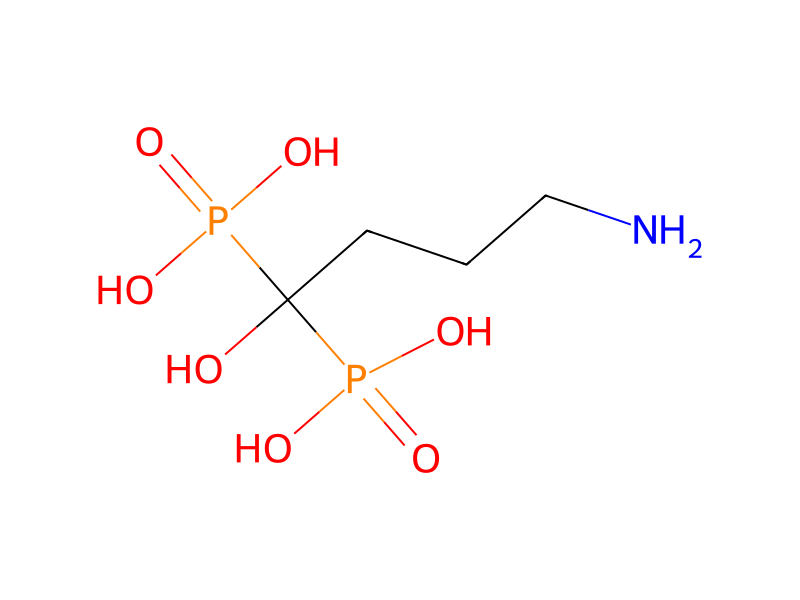
Alendronic Acid → HCID 23051096, compound
Reaction equation

[NH2:1][CH2:2][CH2:3][CH2:4][C:5]([OH:14])([P:10]([OH:13])(=[O:12])[OH:11])[P:6]([OH:9])(=[O:8])[OH:7].[OH-].[Na+].[CH:17](=O)[CH2:18][CH:19]([CH3:21])[CH3:20]>[Pd]>[OH:14][C:5]([P:6]([OH:9])(=[O:7])[OH:8])([P:10]([OH:13])(=[O:11])[OH:12])[CH2:4][CH2:3][CH2:2][NH:1][CH2:17][CH2:18][CH:19]([CH3:21])[CH3:20]Participants
Reactant 3


Product 1

Reagents, catalysts & solvents 1

Procedure
4 g. 4-Amino-1-hydroxybutane-1,1-diphosphonic acid are dissolved in 64 ml. 1N aqueous sodium hydroxide solution, mixed with 3.8 ml. isovaleraldehyde and, after the addition of 2.5 g. of 10% palladium-charcoal, hydrogenated at a pressure of 5 bar. The course of the reaction is monitored electrophoretically until the starting material has disappeared. The reaction mixture is filtered, acidified with Amberlite R 120 (H+ form) and evaporated until crystallisation commences, 1.3 g. of crystals thus being obtained in a yield of 20% of theory; m.p. 225°-227° C. (decomp.); Mrel =0.39. 1-Hydroxy-4-(N-3-methylbutylamino)-butane-1,1-diphosphonic acid remaining in the mother liquor, which is formed as an intermediate, can be used again for the reductive alkylation.
Workup
- filtrationThe reaction mixture is filtered
- customevaporated until crystallisation commences, 1.3 g
- customof crystals thus being obtained in a yield of 20% of theory
Sources & evidence
- ORD record
- ord-2d0c682dfb8e4ec7bff0cb179709f9fc
- Source dataset
- uspto-grants-1990_05
- Patent number
- US04927814
Reaction notes
Loading…