Phosphate → Ethanol, 2-[(3-aminophenyl)sulfonyl]-
Reaction equation

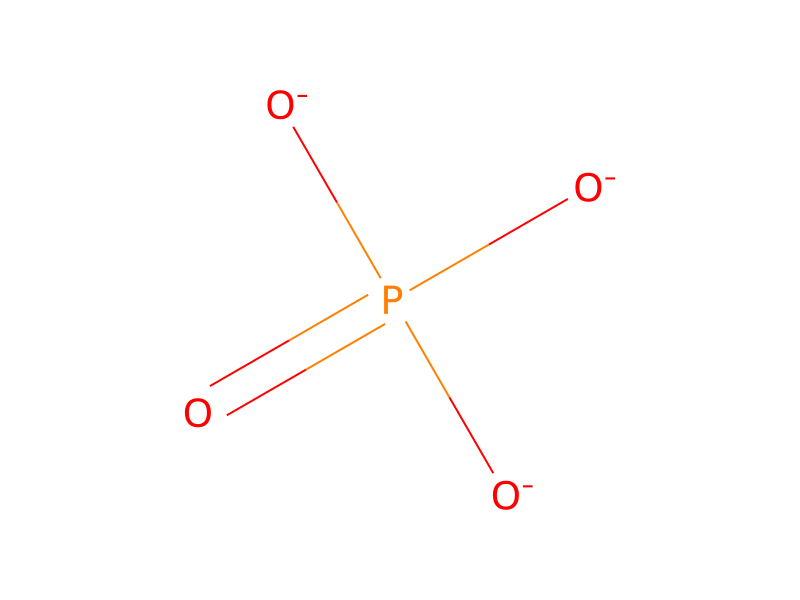
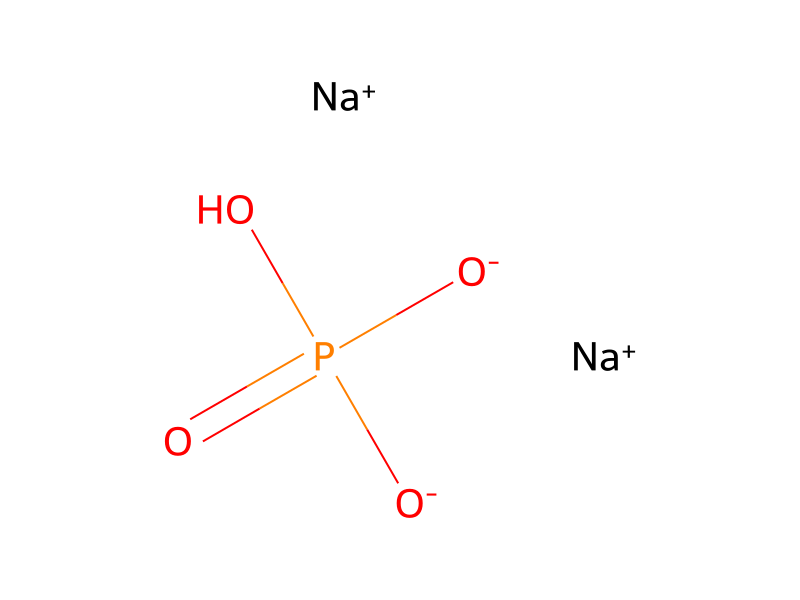
ClC1C=CC([N+]([O-])=O)=CC=1S([O-])=O.[Na+].[OH:15][CH2:16][CH2:17][S:18]([C:21]1[CH:26]=[CH:25][C:24](Cl)=[C:23]([N+:28]([O-])=O)[CH:22]=1)(=[O:20])=[O:19].P([O-])([O-])([O-])=O.P(O)([O-])([O-])=O.[Na+].[Na+].P(O)(O)([O-])=O.[Na+].[H][H]>O.[Ni].[Ni].[Al]>[OH:15][CH2:16][CH2:17][S:18]([C:21]1[CH:26]=[CH:25][CH:24]=[C:23]([NH2:28])[CH:22]=1)(=[O:19])=[O:20]Participants
Reactant 6


Product 1

Reagents, catalysts & solvents 3

Conditions
- Temperature
- 80 °C
Procedure
34.2 g of moist paste of 2-chloro-5-nitrophenyl 2-hydroxyethyl sulphone from Example 1 [or an equimolar amount of 4-chloro-3-nitrophenyl 2-hydroxyethyl sulphone]are stirred into 250 ml of water and 50 ml of a phosphate buffer solution which has been prepared by dissolving 0.5 mole of disodium phosphate and 0.33 mole of monosodium phosphate in 1 l of water. When 1-2 g of a nonionic emulsifier and 1.5 g of Raney nickel, prepared from a 70:30 aluminium-nickel alloy, have been added, the mixture is heated to 80° C. Hydrogen is then injected to 20 bar. The subsequent feed of hydrogen is controlled at such a rate that the pressure is constant at 10-15 bar. When the consumption of hydrogen declines markedly, a sample is withdrawn and examined by chromatography (see Example 1) to check the completeness of the reduction. If, in a given case, 5-amino-2-chlorophenyl 2-hydroxyethyl sulphone [or 3 -amino-4-chlorophenyl 2-hydroxyethyl sulphone] is still detectable, approximately 0.5-1.0 g more catalyst is added and hydrogenation is carried out again at 80° C. and 20 bar. When the reduction and dehalogenation are complete, the pressure in the autoclave is released and the latter is flushed with nitrogen, and the catalyst is removed from the warm reaction solution by suction filtration. The solution is cooled and acidified with hydrochloric acid, and the content of 3-aminophenyl 2-hydroxyethyl sulphone in the solution is determined by diazotization with 10% strength sodium nitrite solution. The yield is approximately 90% of theory. The solution of 3-aminophenyl 2-hydroxyethyl sulphone thus obtained can be processed further directly in this form; it can, for example, be diazotized and the diazonium salt solution can be coupled, as described in Japanese Patent Application No. 05,667/70, with 7-acetylamino-1-naphthol-3-sulphonic acid.
Workup
- customhas been prepared
- additionhave been added
- customWhen the consumption of hydrogen
- customa sample is withdrawn
- additionapproximately 0.5-1.0 g more catalyst is added
- customis carried out again at 80° C.
- customthe latter is flushed with nitrogen
- customthe catalyst is removed from the warm reaction solution by suction filtration
- temperatureThe solution is cooled
Sources & evidence
- ORD record
- ord-9a6f839720e04fcbb79e470315f15450
- Source dataset
- uspto-grants-1990_05
- Patent number
- US04929757
Reaction notes
Loading…