Pyridine → 2-bromo-N-(4-(trifluoromethoxy)phenyl)propanamide
Reaction equation

[Br:1][CH:2]([CH3:6])[C:3](Cl)=[O:4].Cl.[F:8][C:9]([F:19])([F:18])[O:10][C:11]1[CH:17]=[CH:16][C:14]([NH2:15])=[CH:13][CH:12]=1.N1C=CC=CC=1>C(Cl)Cl>[Br:1][CH:2]([CH3:6])[C:3]([NH:15][C:14]1[CH:16]=[CH:17][C:11]([O:10][C:9]([F:8])([F:18])[F:19])=[CH:12][CH:13]=1)=[O:4]Participants
5
Reactant 3

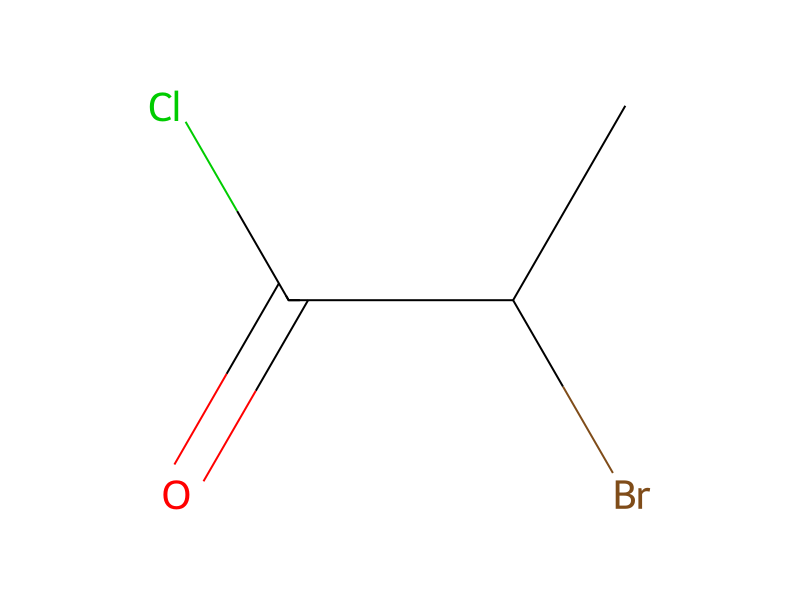

Product 1

Reagents, catalysts & solvents 1

Procedure
A solution of 4.02 g (23.4 mmol) of 2-bromopropionyl chloride in 10 ml of methylene chloride was added to an ice-cooled solution of 5.0 g (23.4 mmol) of 4-(trifluoromethoxy)aniline hydrochloride, 4.65 g (59 mmol) of pyridine and 30 ml of methylene chloride. The mixture was stirred at ambient temperature for a period of 2.5 hours and then washed with two portions of dilute aqueous HCl and two portions of saturated aqueous sodium bicarbonate, dried over MgSO4, treated with charcoal, filtered and the filtrates evaporated to dryness. The residue was recrystallized from methylcyclohexane to give 5.43 g 74 percent of theoretical) of the above-named product as colorless crystals, m.p. 111°-112° C.
Workup
- washwashed with two portions of dilute aqueous HCl and two portions of saturated aqueous sodium bicarbonate
- dry with materialdried over MgSO4
- additiontreated with charcoal
- filtrationfiltered
- customthe filtrates evaporated to dryness
- customThe residue was recrystallized from methylcyclohexane
Sources & evidence
- ORD record
- ord-dd9c798f3f424ef982fb3206e63b003d
- Source dataset
- uspto-grants-1993_10
- Patent number
- US05250690
Reaction notes
Loading…