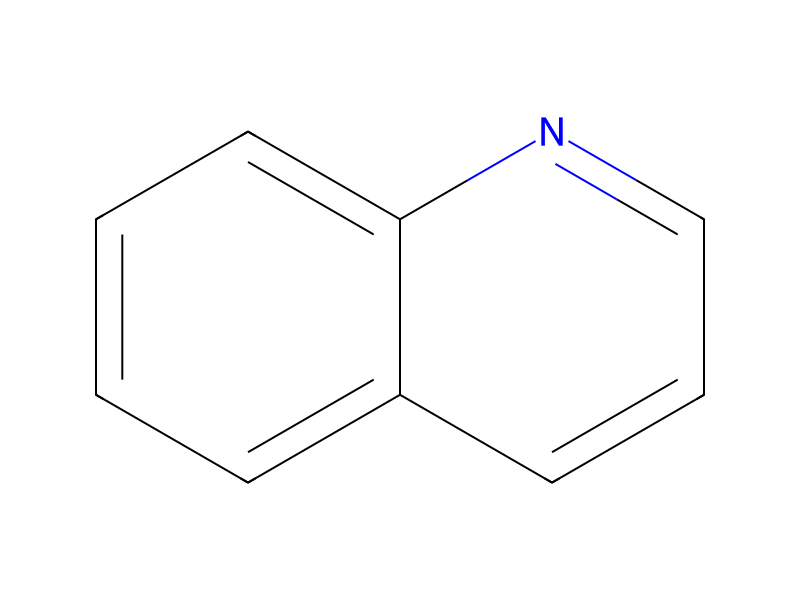
Quinoline → HCID 67808707, compound
Reaction equation

[N:1]1[C:10]2[C:5](=[CH:6][CH:7]=[CH:8][CH:9]=2)[CH:4]=[CH:3][CH:2]=1.[C:11](OCC)(=[O:13])[CH3:12]>[Pd].CC([O-])=O.CC([O-])=O.[Pb+2]>[N:1]1[CH:2]=[CH:3][CH:4]=[C:5](/[CH:6]=[CH:7]\[CH2:8][CH2:9][CH2:12][CH2:11][OH:13])[CH:10]=1Participants
Reactant 2

Product 1

Reagents, catalysts & solvents 1
Procedure
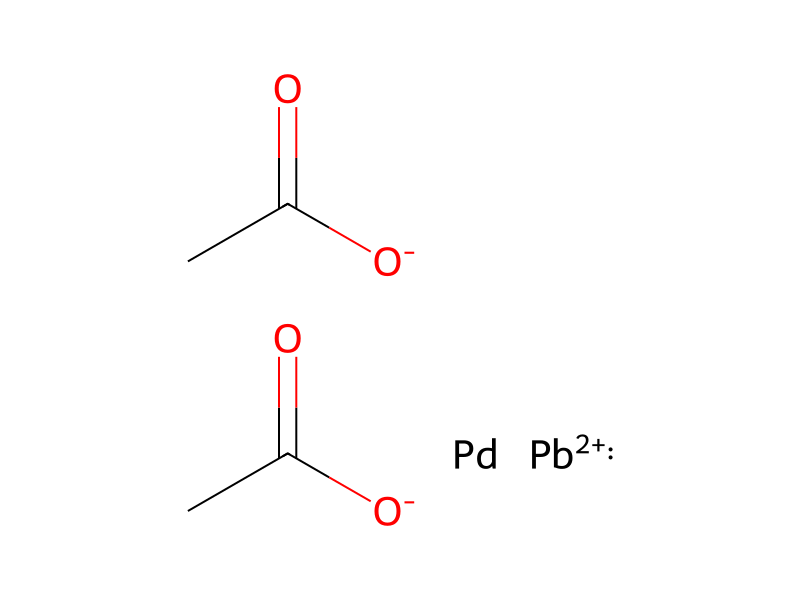
A solution of 45 ml (0.47 mol) of 3-bromopyridine and 52 g (0.53 mol) of 5-hexyn-l-ol in 150 ml of triethylamine and 500 ml of dichloromethane is degassed for 15 minutes with argon, and 3 g (4,3 mmol) of bis(triphenylphosphine)palladium(II)chloride and 450 mg of cuprous iodide is added. The mixture is heated at reflux for 3 h. The cooled reaction mixture is diluted with 1 liter of dichloromethane and is washed with water and brine, dried (K2CO3), concentrated and bulb-to-bulb distilled (b.p. 120°-130° C./0.05 mbar), to give 63 g of 6-(3-pyridyl)hex-5-ynol as a yellow oil, which is dissolved in 500 ml of ethyl acetate and af ter addition of 15 ml of quinoline is hydrogenated f or 5 h over 6 g Lindlar catalyst (Pb-poisoned Pd catalyst) in a Parrhydrogenator. The crude product is evaporatively distilled (b.p. 120°-130° C./0.05 mbar), yielding 61 g (73%) of (Z)-6-(3-pyridyl)hex-5-enol as a colourless viscous liquid. (C11H15NO; F.W. 177.3).
Workup
- customf or 5 h
- distillationThe crude product is evaporatively distilled (b.p. 120°-130° C./0.05 mbar)
Sources & evidence
- ORD record
- ord-7000ae8abb404e90bc823b0be5a71c6d
- Source dataset
- uspto-grants-1993_10
- Patent number
- US05254549
Reaction notes
Loading…