4-Hydroxybenzoic Acid → Phenylparaben
Reaction equation

[OH:1][C:2]1[CH:10]=[CH:9][C:5]([C:6]([OH:8])=[O:7])=[CH:4][CH:3]=1.C(O[C:15]1[CH:20]=[CH:19][CH:18]=[CH:17][CH:16]=1)(=O)C>>[OH:1][C:2]1[CH:10]=[CH:9][C:5]([C:6]([O:8][C:15]2[CH:20]=[CH:19][CH:18]=[CH:17][CH:16]=2)=[O:7])=[CH:4][CH:3]=1Participants
Reactant 2
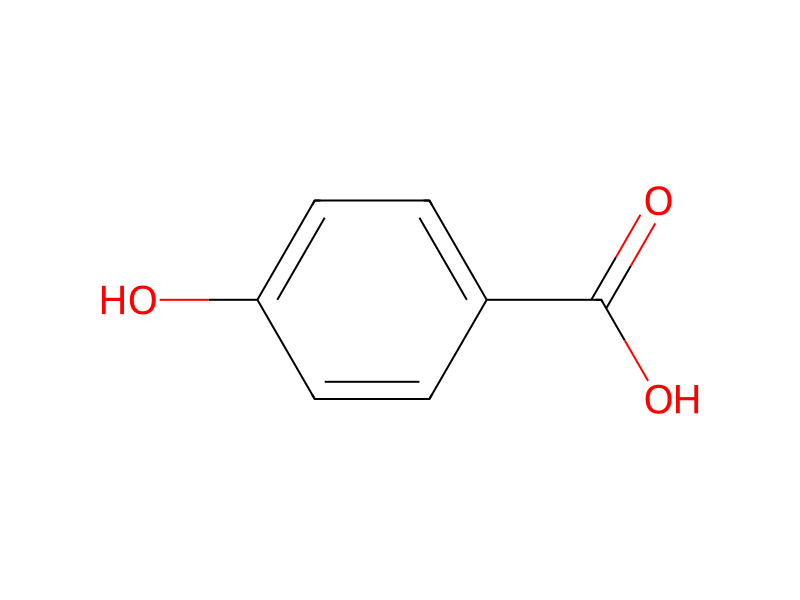

Product 1

Conditions
- Temperature
- 180 °C
Procedure
828 g. (6 moles) of p-hydroxybenzoic acid and 1020 g. (6.5 moles) of phenyl acetate are charged into a four-necked resin kettle equipped as in Example 3. The reaction mixture is stirred constantly under a nitrogen atmosphere throughout the run. The reaction mixture is heated to 180°C, and gaseous HCl is then bubbled through the mixture for 7 hours, the temperature being held at 180°C. Phenyl p-hydroxybenzoate is produced thereby. The HCl flow is discontinued and 660 g. (6 moles) of hydroquinone is added to the charge. The distilling head is heated to 180°C, and the reaction mixture is heated from 180°C to 230°C at a rate of 10°C/hour, held for 4.5 hours at 230+C, and heated to 240°C where the temperature is held for 2 hours. The resulting pasty melt is poured while hot into a tray and allowed to cool and solidify, whereupon it is pulverized. A yield of 1413 g. is obtained. The product consists primarily of an ester, p-hydroxyphenyl p-hydroxybenzoate, having Formula XVII wherein R4 and R9 are each hydrogen, n is 0, and the dioxyarylene moiety is para-dioxyphenylene. The product also contains a linear polyester identical to that produced in Example 6. The desired ester is separable from the linear polyester by virtue of its greater solubility in such solvents as acetone. Accordingly, the product is extracted with hot acetone to obtain a solution of the ester and water is added to the solution to precipitate the ester, which is removed by filtration, dried in vacuum, and crystallized from aqueous isopropyl alcohol. The ester is found to have a melting point of 243°C upon differential thermal analysis.
Workup
- customequipped as in Example 3
- customgaseous HCl is then bubbled through the mixture for 7 hours
- custombeing held at 180°C
Sources & evidence
- ORD record
- ord-ef7b653a133a46da82782b17f814c29d
- Source dataset
- uspto-grants-1976_06
- Patent number
- US03962314
Reaction notes
Loading…