4-Hydroxybenzoic Acid → Phenylparaben
Reaction equation

[OH:1][C:2]1[CH:10]=[CH:9][C:5]([C:6]([OH:8])=[O:7])=[CH:4][CH:3]=1.C(O[C:15]1[CH:20]=[CH:19][CH:18]=[CH:17][CH:16]=1)(=O)C.C(OC1C=CC=CC=1)(=O)C1C=CC=C(C(OC2C=CC=CC=2)=O)C=1>>[OH:1][C:2]1[CH:10]=[CH:9][C:5]([C:6]([O:8][C:15]2[CH:20]=[CH:19][CH:18]=[CH:17][CH:16]=2)=[O:7])=[CH:4][CH:3]=1Participants
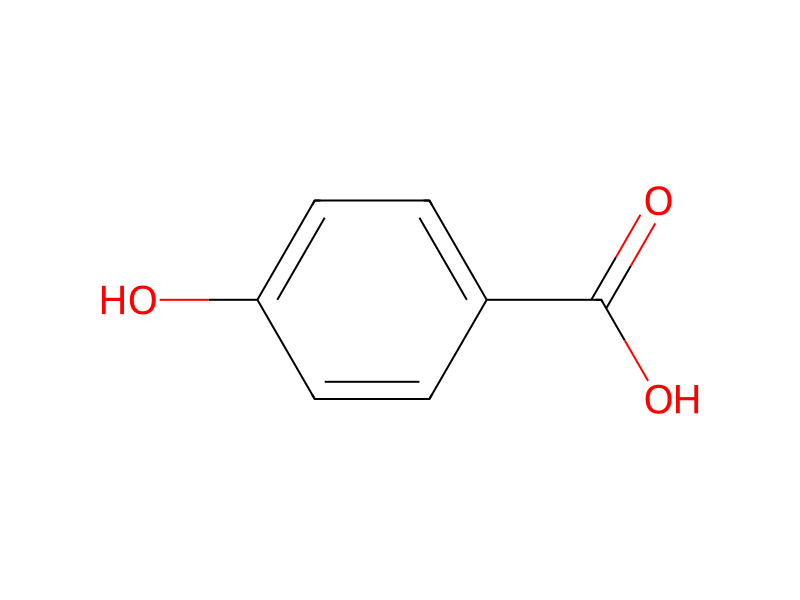


Conditions
- Temperature
- 180 °C
Procedure
138 g. (1 mole) of p-hydroxybenzoic acid, 170 g. (1.25 moles) of phenyl acetate and 39.75 g. (0.125 mole) of diphenyl isophthalate are placed in a four-necked resin kettle equipped as in Example 3. The mixture is heated to 180°C, and HCl is then bubbled through the resulting melt for 8 hours, during which the temperature is held at 180°C for 6 hours and subsequently at 200°C for 2 hours. Phenyl p-hydroxybenzoate is produced thereby. The HCl flow is discontinued, and 30.6 g. (0.250 mole) of hydroquinone and 500 g. of a polyaromatic ether heat transfer medium (b.p above 400°C) are added. The temperature is then raised to 280°C where it is held for 1 hour, raised to 300°C where it is held for 2 hours, and raised to 320°C where it is held for 5 hours. The mixture is cooled and acetone is added. The product is recovered by filtration, washed with acetone, extracted with acetone overnight in a Soxhlet extractor, and dried in vacuum at 110°C. The product is a linear copolyester consisting essentially of moieties of Formulas II, III and IV in a ratio of about 8:1:1, wherein the moiety of Formula III is isophthaloyl and the moiety of Formula IV is para-dioxyphenylene, and the average number of moieties in the copolyester chain is about 10.
Workup
- customequipped as in Example 3
- customHCl is then bubbled through the resulting
- waitthe temperature is held at 180°C for 6 hours and subsequently at 200°C for 2 hours
Sources & evidence
- ORD record
- ord-07239a00fbea43fcbdea11e52bb6b715
- Source dataset
- uspto-grants-1976_06
- Patent number
- US03962314
Reaction notes
Loading…