Chloromethyl Methyl Ether → HCID 21531695, compound
Reaction equation

[Br:1][C:2]1[C:3]([CH:13]([CH3:15])[CH3:14])=[C:4]([CH:6]=[C:7]([CH:10]([CH3:12])[CH3:11])[C:8]=1[OH:9])[OH:5].[Cl:16][CH2:17]OC>C(=S)=S>[Br:1][C:2]1[C:8]([OH:9])=[C:7]([CH:10]([CH3:11])[CH3:12])[C:6]([CH2:17][Cl:16])=[C:4]([C:3]=1[CH:13]([CH3:15])[CH3:14])[OH:5]Participants
4
Reactant 2
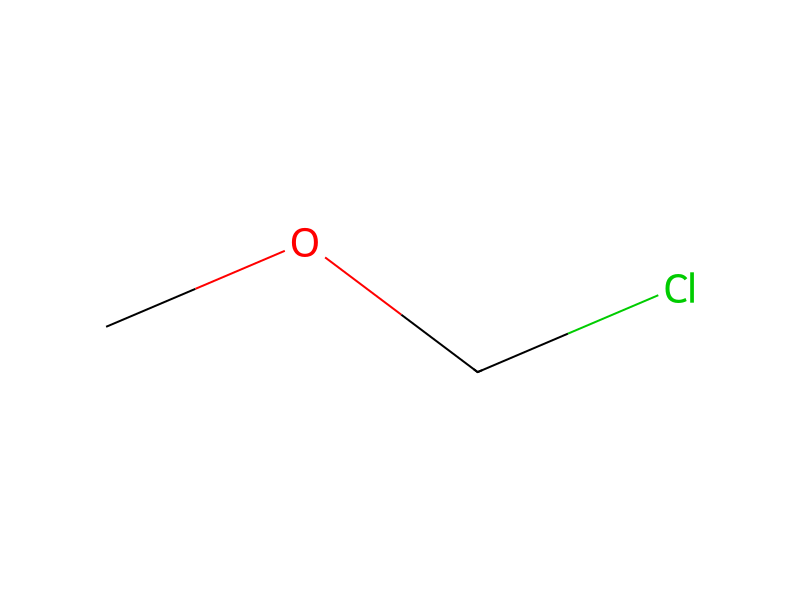

Product 1

Reagents, catalysts & solvents 1

Procedure
Two hundred seventy-three parts of 3-bromo-2,5-diisopropylhydroquinone is allowed to react with 130 parts of chloromethylmethyl ether and 80 parts of stannic chloride in 400 parts of carbon disulfide under general conditions set forth in "Organic Reactions", Vol. 1, p. 68 and 69. The reaction mixture is poured on ice, and the organic layer is separated and dried over anhydrous calcium sulfate. The solvent is allowed to evaporate and the residue is crystallized to give a pure sample of the title compound. Chloromethylation of the following monohalo- or dihalodialkylhydroquinones or resorcinols gives the corresponding chloromethyl derivatives.
Workup
- additionThe reaction mixture is poured on ice
- customthe organic layer is separated
- dry with materialdried over anhydrous calcium sulfate
- customto evaporate
- customthe residue is crystallized
Sources & evidence
- ORD record
- ord-d791c1ff5ef6413084f07e769df1b00c
- Source dataset
- uspto-grants-1976_06
- Patent number
- US03962307
Reaction notes
Loading…