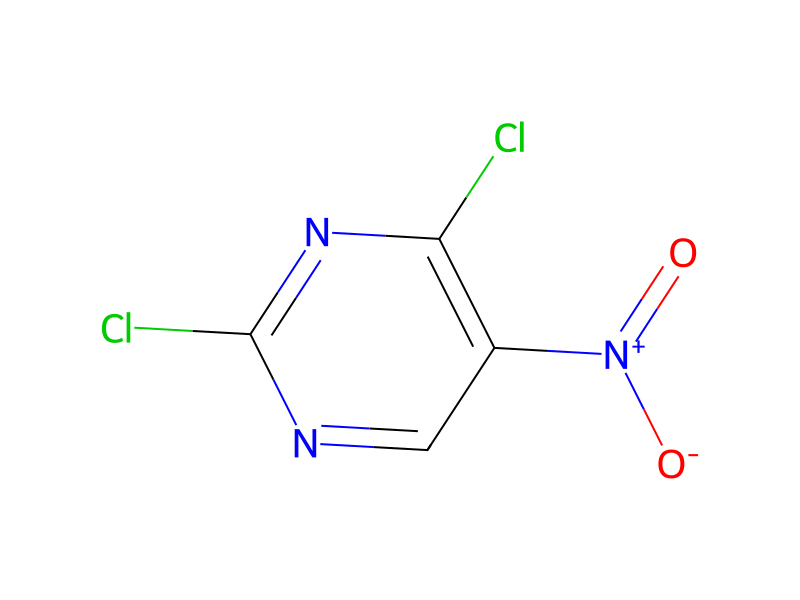
2,4-Dichloro-5-nitropyrimidine → HCID 11789809, compound
Reaction equation

ClC1N=C(Cl)C([N+]([O-])=O)=CN=1.[N+:12]([NH:15][C@H:16]([C:24]([OH:26])=[O:25])[CH2:17][C:18]1[CH:23]=[CH:22][CH:21]=[CH:20][CH:19]=1)([O-])=O>[Pd]>[NH2:12][NH:15][C@H:16]([C:24]([OH:26])=[O:25])[CH2:17][C:18]1[CH:23]=[CH:22][CH:21]=[CH:20][CH:19]=1Participants
Reactant 2

Product 1

Reagents, catalysts & solvents 1

Procedure
2,4-dichloro-5-nitropyrimidine is first coupled to a nitrophenylalanine derivative and the product is allowed to react with a dialkylamine, either directly or utilizing “Buchwald” palladium catalyzed coupling conditions. The resulting product is then hydrogenated yielding an aminophenylalanine derivative. This is coupled to 2-chloro-3-nitropyridine followed by reduction of the nitro group. Cyclization with CDI followed by alkylation with methyl iodide or other alkylating agent gives the imidazolone. Reduction of the pyrimidine nitro group followed by the introduction of the N-isopropyl group through reductive amination followed by sulfonylation with a sulfonyl chloride (or alternatively acylation with an acid chloride) gives the ester. Hydrolysis with formic acid affords the product.
Sources & evidence
- ORD record
- ord-e66b331e48034d06ae145a3ee1466b88
- Source dataset
- uspto-grants-2011_10
- Patent number
- US08030328B2
Reaction notes
Loading…