2-Thiophenecarboxaldehyde → HCID 66626031, compound
Reaction equation
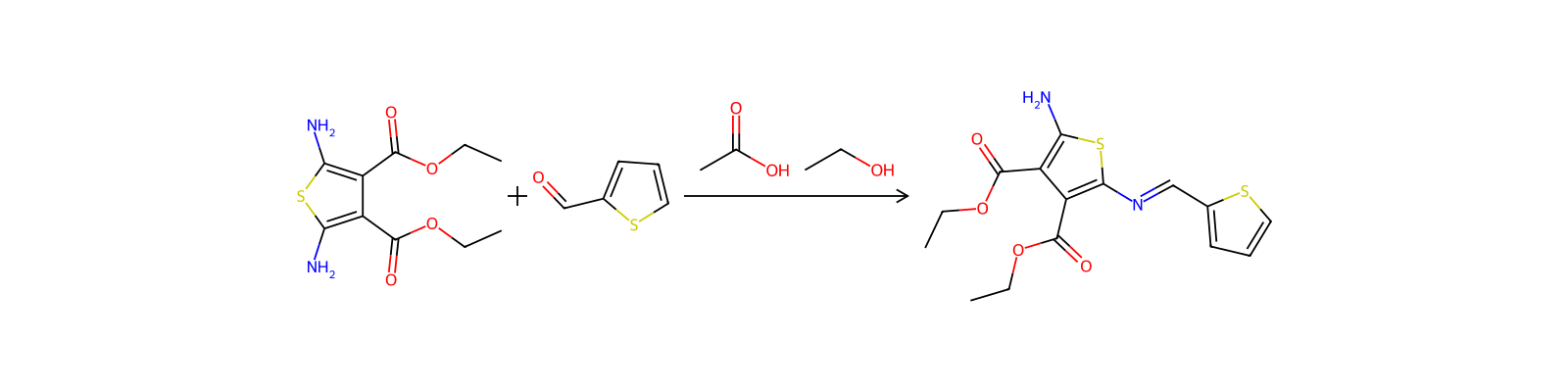
[CH2:1]([O:3][C:4]([C:6]1[C:10]([C:11]([O:13][CH2:14][CH3:15])=[O:12])=[C:9]([NH2:16])[S:8][C:7]=1[NH2:17])=[O:5])[CH3:2].[S:18]1[CH:22]=[CH:21][CH:20]=[C:19]1[CH:23]=O>C(O)(=O)C.C(O)C>[CH2:1]([O:3][C:4]([C:6]1[C:10]([C:11]([O:13][CH2:14][CH3:15])=[O:12])=[C:9]([N:16]=[CH:23][C:19]2[S:18][CH:22]=[CH:21][CH:20]=2)[S:8][C:7]=1[NH2:17])=[O:5])[CH3:2]Participants
Reactant 2


Product 1

Reagents, catalysts & solvents 2


Procedure
In a 250 mL flask comprising 50 ml absolute ethanol, was dissolved 2,5-diamino-thiophene-3,4-dicarboxylic acid diethyl ester (470 mg, 5.0 mmol) followed by 2-thiophene carboxaldehyde (646 mg, 2.5 mmol). After the addition of one drop of acetic acid, the solution was stirred at room temperature for 4 days. The solvent was then removed from the resulting orange solution and the residue was purified by flash chromatography (SiO2) using 20% ethyl acetate/hexane to afford the title compound as a yellow solid (454 mg, 52%). M.p.=145°-147° C. 1H-NMR (200 MHz, [D] chloroform): δ=9.94 (s, 1H), 8.06 (s, 1H), 7.20 (t, 1H), 7.18 (d, 1H), 7.12 (m, 1H), 7.02 (m, 1H), 4.41 (t, 2H), 4.24 (q, 2H), 1.48 (t, 3H), 1.29 (t, 3H). 13C-NMR (50 MHz, [D] chloroform): δ=164.5, 159.9, 145.9, 142.7, 134.0, 131.2, 130.2, 127.9, 102.9, 61.6, 60.3, 14.5, 14.3. FAB-MS: m/z 351.8 ([M]+, 100%). Anal. calc. for C15H16N2O4S2 (352.06): C, 51.12, H, 4.58, N, 7.95, O, 18.16, S, 18.20 found: C, 51.21; H, 4.63; N, 7.77, S, 17.81. λmax (DMSO)=402 nm. ε (DMSO)=3.6×10⁴ M−1 dm−1; λmax (acetonitrile)=408 nm, λfl(acetonitrile)=604 nm.
Workup
- customIn a 250 mL flask comprising
- customThe solvent was then removed from the resulting orange solution
- customthe residue was purified by flash chromatography (SiO2)
Sources & evidence
- ORD record
- ord-9a8909a1fb9449318c07a42aa2435a74
- Source dataset
- uspto-grants-2011_10
- Patent number
- US08034895B2
Reaction notes
Loading…