Reaction Steps
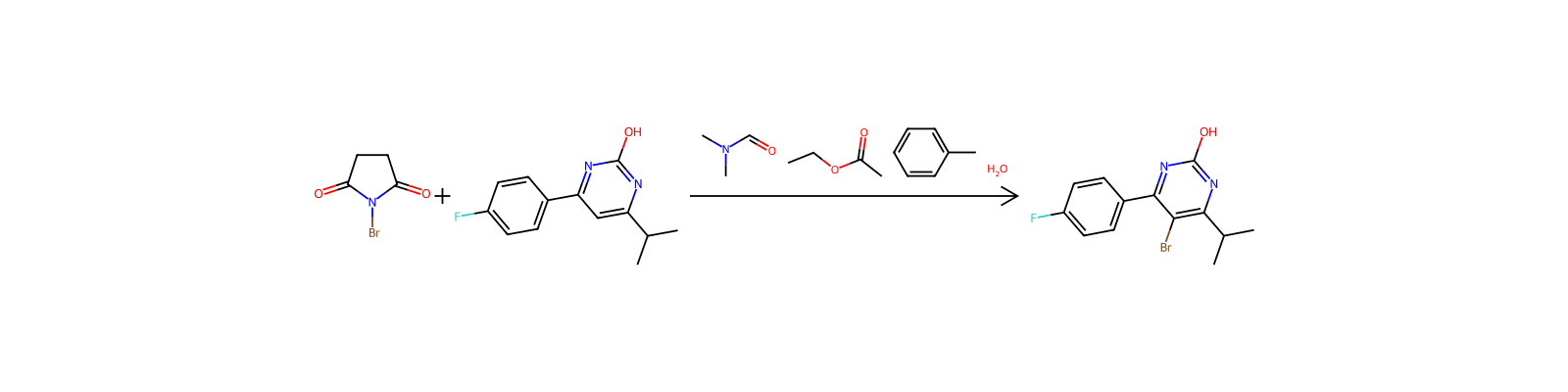
A 5M to 6M solution of hydrogen chloride in isopropanol (38 mL, 194 mmoles) was added to a stirred mixture of urea (7.78 g, 129.6 mmoles) and 1-(4-fluorophenyl)-4-methylpentane-1,3-dione (8.43 g, 32.4 mmoles) in ethanol (49 mL). The reaction mixture was refluxed for 40 hours and then cooled to −6° C. The resultant precipitate was collected by filtration and washed with diethyl ether (20 mL). The solid was added to water (60 mL) and saturated aqueous sodium bicarbonate solution (10 mL). Further solid sodium bicarbonate (16.4 g, 195 mmoles) was added portionwise. The mixture was diluted with acetone (40 mL) and ethyl acetate (80 mL). The organic phase was separated and aqueous phase was extracted 2:1 ethyl acetate/acetone (3×120 mL). The organic phases were combined, washed with brine (30 mL), dried with anhydrous magnesium sulfate and concentrated in vacuo to yield 4.8 g of 4-(4-fluorophenyl)-6-isopropylpyrimidin-2-ol (64% yield); 1H NMR (400 MHz) (CDCl3) δ TMS: 1.41 (6H, d, J=6.90 Hz), 3.08 (1H, m), 6.69 (1H, s), 7.17 (2H, dd, J=8.60 Hz, J=8.60 Hz), 8.14 (2H, dd, J=6.65 Hz, J=6.65 Hz), 13.57 (1H, br. s). Mp: 215-217° C. HRMS calculated for C13H13N2OF. 232.1012, found 232.0963; used in subsequent reaction without further purification. (ii) N-Bromosuccinimide (3.504 g, 19.69 mmoles) was added to suspension of 4-(4-fluorophenyl)-6-isopropylpyrimidin-2-ol (4.573 g, 19.69 mmoles) in DMF (30 mL) at −8.5° C. The mixture was stirred for 10 minutes and the reaction mixture was allowed to warm to ambient temperature. The mixture was stirred for 4 hours and then diluted with ethyl acetate (80 mL), toluene (20 mL), and water (100 mL). The organic phase was separated, and the aqueous phase extracted with 4:1 ethyl acetate/toluene (2×100 mL). The organic phases were combined and diluted with acetone (100 mL). The solution was washed with brine (75 mL), followed by saturated aqueous sodium bicarbonate (40 mL), and then concentrated in vacuo (with 3×40 mL toluene azeotropes) to yield 6.031 g of 5-bromo-4-(4-fluorophenyl)-6-isopropylpyrimidin-2-ol (98% yield); 1H NMR (400 MHz) (CDCl3) 6 TMS: 1.39 (6H, d, J=6.90 Hz), 3.57 (1H, m), 7.16 (2H, dd, J=8.60 Hz, J=8.60 Hz), 7.66 (2H, dd, J=8.70 Hz, J=5.40 Hz). Mp: Decomposes at 199° C. HRMS calculated for C13H12N2OFBr 310.0117, found 310.0116; used in subsequent reaction without further purification. (iii) Phosphoryl chloride (5.00 mL, 53.8 mmoles) was added to 5-bromo-4-(4-fluorophenyl)-6-isopropylpyrimidin-2-ol (5.027 g, 15.28 mmoles) and the reaction mixture was heated to an internal temperature of 90° C. The mixture was then stirred for 150 minutes at this temperature, then allowed to cool to 25° C. The reaction mixture was quenched by dropwise addition (with 30 mL of EtOAc rinses) into a stirred mixture of ice (60 g), water (40 mL), and sodium bicarbonate (10 g). After completion of the addition, sodium bicarbonate (13 g) added to assure neutrality. The mixture was then extracted with ethyl acetate (4×70 mL). The organic phases were combined and dried with anhydrous magnesium sulphate. The solution was filtered through a pad of diatomaceous earth, and concentrated in vacuo to yield 5-bromo-2-chloro-4-(4-fluorophenyl)-6-isopropylpyrimidine (4.98 g, 99% yield); 1H NMR (400 MHz) (CDCl3) 6 TMS: 1.34 (6H, d, J=6.70 Hz), 3.64 (1H, m), 7.17 (2H, dd, J=8.65 Hz, J=8.65 Hz), 7.73 (2H, dd, J=8.80 Hz, J=5.20 Hz). Mp: 99-101° C. HRMS calculated for C13H11N2FClBr 327.9778, found 327.9752; used in subsequent reaction without further purification. (iv) Sodium hydride (1.20 g, 30.0 mmol, 60% suspension in mineral oil) was washed with hexane (2×10 mL), and DMF (50 mL) was then added, followed by 5-bromo-2-chloro-4-(4-fluorophenyl)-6-isopropylpyrimidine (4.944 g, 15.0 mmoles). The resulting suspension was cooled to −7° C. and N-methylmethanesulfonamide (2.585 g, 22.5 mmoles) was added, washed in with DMF (10 mL). The mixture was stirred for 17.5 hours, then diluted with ethyl acetate (80 mL), toluene (100 mL), and water (120 mL). The organic phase was separated, and the aqueous phase was extracted with a mixture of ethyl acetate (20 mL) and toluene (30 mL). The organic phases were combined, washed with water (2×40 mL) and then brine (20 mL), and dried over anhydrous magnesium sulphate. The solution was concentrated in vacuo (with two 20 mL hexane azeotropes) to yield N-(5-bromo-4-(4-fluorophenyl)-6-isopropylpyrimidin-2-yl)-N-methylmethanesulfonamide (5.50 g, 91% yield); 1H NMR (400 MHz) (CDCl3) δ TMS: 1.32 (6H, d, J=6.60 Hz), 3.49 (3H, s), 3.55 (3H, s), 3.63 (1H, m), 7.16 (2H, dd, J=8.65 Hz, J=8.65 Hz), 7.77 (2H, dd, J=8.70 Hz, J=5.30 Hz). Mp: 122-125° C. HRMS calculated for C13H17N3O2FSBr 401.0209, found 401.0225; used in subsequent reaction without further purification.