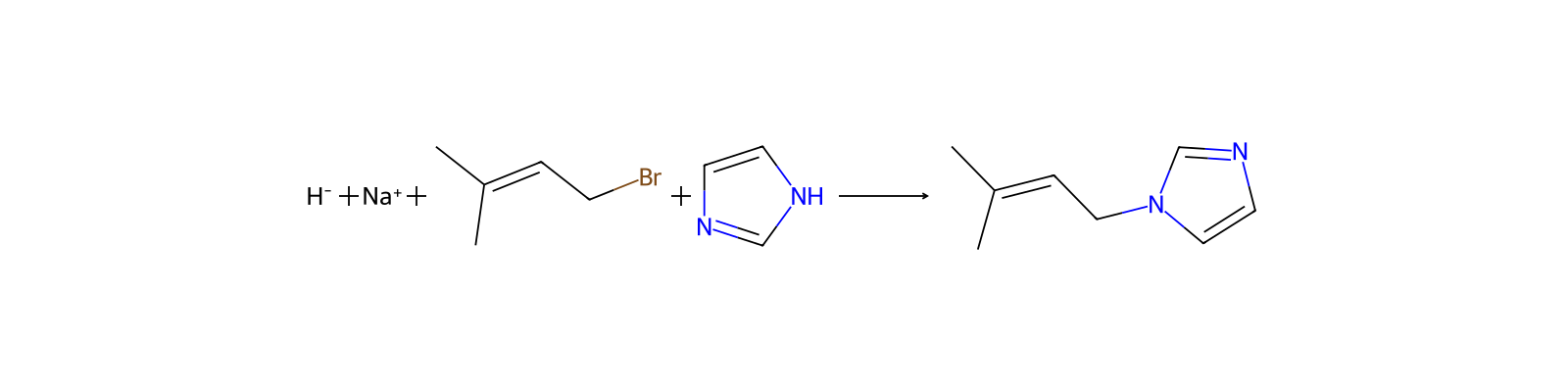
Participants
| Role | Name | HCID | Charge |
|---|
| Reactant | Imidazole | HCID 795 | — |
| Reactant | Sodium hydride | HCID 24758 | — |
| Reactant | 2-Butene, 1-bromo-3-methyl- | HCID 70092 | — |
| Product | HCID 57339814 | HCID 57339814 | 54.4% |
Reaction Steps
Sodium hydride (1.37 g 60% dispersion in oil, 0.82 g; 34.2 mmol) was weighed out in a 100 mL round bottom flask, and washed with hexane (3×15 mL) to remove the mineral oils. DMF (anhydrous, 15 mL) was added to the sodium hydride and the whole was stirred at room temperature for a couple of minutes under N2. 3,3-Dimethylallyl bromide (1.05 g, 7.02 mmol) was added to the reaction mixture, followed by slow addition of imidazole (2.28 g, 33.5 mmol) while cooling in an ice bath. The mixture was a milky cream colour initially, turning into a homogeneous brown solution. Stirring was continued at room temperature for 20 h. When the TLC showed complete consumption of the dimethylallyl bromide, the DMF was distilled off at 120° C. under high vacuum (Kugelrohr), leaving a viscous yellow heterogeneous mixture. This was triturated with chloroform to give a brown organic layer after removing the precipitated solids by filtration. The organic layer was washed with brine (3×20 mL), dried (Na2SO4) and the solvent was removed under reduced pressure and then under high vacuum. This gave the product as a dark brown oil (0.52 g, 54%).
Provenance & Evidence
| DOI | 10.6084/m9.figshare.5104873.v1 |
|---|
| Patent number | US08038737B2 |
|---|
| Source dataset | uspto-grants-2011_10 |
|---|
| ORD ID | ord-58c964cb936c47b2b82af51c23533a5c |
|---|
| Source note | uspto-grants-2011_10 |
|---|