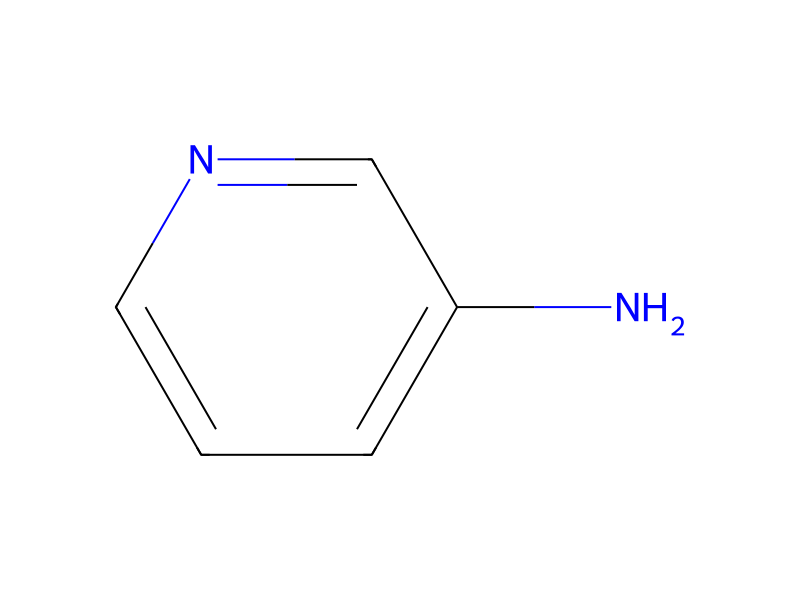
3-Aminopyridine → HCID 24964058, compound
Reaction equation

FC(F)(F)C(O)=O.[Br:8][C:9]1[CH:10]=[N:11][C:12]([O:15][C:16]2[CH:21]=[CH:20][CH:19]=[C:18]([CH:22]=[C:23]3[CH2:28][CH2:27][NH:26][CH2:25][CH2:24]3)[CH:17]=2)=[N:13][CH:14]=1.[N:29]1[CH:34]=[CH:33][CH:32]=[C:31]([NH:35][C:36](=O)[O:37]C2C=CC=CC=2)[CH:30]=1.NC1C=NC=CC=1.C(N(C(C)C)CC)(C)C>C(#N)C>[Br:8][C:9]1[CH:10]=[N:11][C:12]([O:15][C:16]2[CH:17]=[C:18]([CH:19]=[CH:20][CH:21]=2)[CH:22]=[C:23]2[CH2:28][CH2:27][N:26]([C:36]([NH:35][C:31]3[CH:30]=[N:29][CH:34]=[CH:33][CH:32]=3)=[O:37])[CH2:25][CH2:24]2)=[N:13][CH:14]=1Participants




Procedure
5-Bromo-2-(3-(piperidin-4-ylidenemethyl)phenoxy)pyrimidine trifluoroacetate (0.315 mmol, from Step 5), in acetonitrile (1.5 mL) was treated with phenyl pyridin-3-ylcarbamate (75 mg, 0.35 mmol, prepared according to the procedure described in Synthesis, 1997, 1189-1194 from 3-aminopyridine) and diisopropylethylamine (0.192 mL, 1.10 mmol) and stirred at room temperature. After 72 h, the reaction was concentrated and the residue was purified by flash chromatography on silica gel (0-10% ethanol (containing 11% aq NH4OH):dichloromethane) to afford the title compound (0.114 g, 78% yield) as a white foam. MS (APCI) M+1=466; 1H NMR (400 MHz, CDCl3) δ ppm 2.48 (t, J=5.36 Hz, 2H) 2.61 (t, J=5.36 Hz, 2H) 3.55-3.63 (m, 2H) 3.66-3.73 (m, 2H) 6.41 (s, 1H) 7.01-7.09 (m, 2H) 7.12 (d, J=7.80 Hz, 1H) 7.40 (t, J=7.80 Hz, 1H) 7.43-7.48 (m, 1H) 7.89 (br. s., 1H) 8.21 (d, J=4.29 Hz, 1H) 8.48 (d, J=8.97 Hz, 1H) 8.58 (s, 2H) 8.88 (br. s, 1H).
Workup
- customprepared
- concentrationthe reaction was concentrated
- customthe residue was purified by flash chromatography on silica gel (0-10% ethanol (containing 11% aq NH4OH):dichloromethane)
Sources & evidence
- ORD record
- ord-359d7c7036eb4050985f8dbafe6c5040
- Source dataset
- uspto-grants-2011_10
- Patent number
- US08044052B2
Reaction notes
Loading…