Sodium Hydroxide → 3-Bromo-5-hydroxybenzoic acid
Reaction equation

[OH-:1].[Na+].[Br:3][C:4]1[CH:5]=[C:6]([CH:10]=[C:11](I)[CH:12]=1)[C:7]([OH:9])=[O:8]>O>[Br:3][C:4]1[CH:5]=[C:6]([CH:10]=[C:11]([OH:1])[CH:12]=1)[C:7]([OH:9])=[O:8]Participants
4
Reactant 2

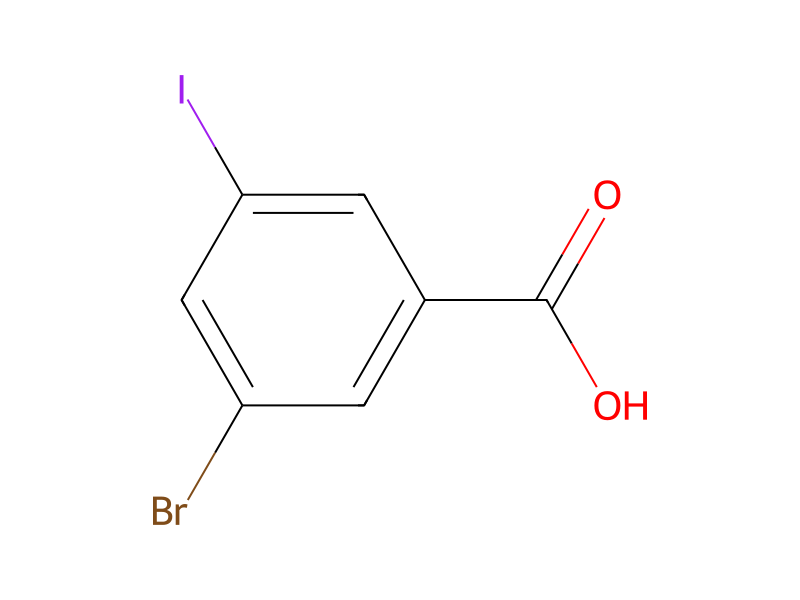
Product 1

Reagents, catalysts & solvents 1

Conditions
- Temperature
- 100 °C
Procedure
To a solution of NaOH (12.2 g; 305.8 mmol) in 300 mL of water was added 3-bromo-5-iodo-benzoic acid (20 g, 61.2 mmol) and Cu2O (866 mg, 6.1 mmol). The reaction mixture was heated at 100° C. for 24 h. After complete consumption of the starting material, the reaction mixture was cooled to room temperature and filtered through Celite™. The filtrate was then acidified with 10% aq. HCl and extracted into ethyl acetate. The organic extract was dried over anhydrous sodium sulfate and concentrated under reduced pressure to afford the title compound as a tan solid (12.3 g, 93% yield).
Workup
- customAfter complete consumption of the starting material
- temperaturethe reaction mixture was cooled to room temperature
- filtrationfiltered through Celite™
- extractionextracted into ethyl acetate
- extractionThe organic extract
- dry with materialwas dried over anhydrous sodium sulfate
- concentrationconcentrated under reduced pressure
Sources & evidence
- ORD record
- ord-6f8a4781aeca4539ae7d434d61fad052
- Source dataset
- uspto-grants-2011_08
- Patent number
- US07989454B2
Reaction notes
Loading…