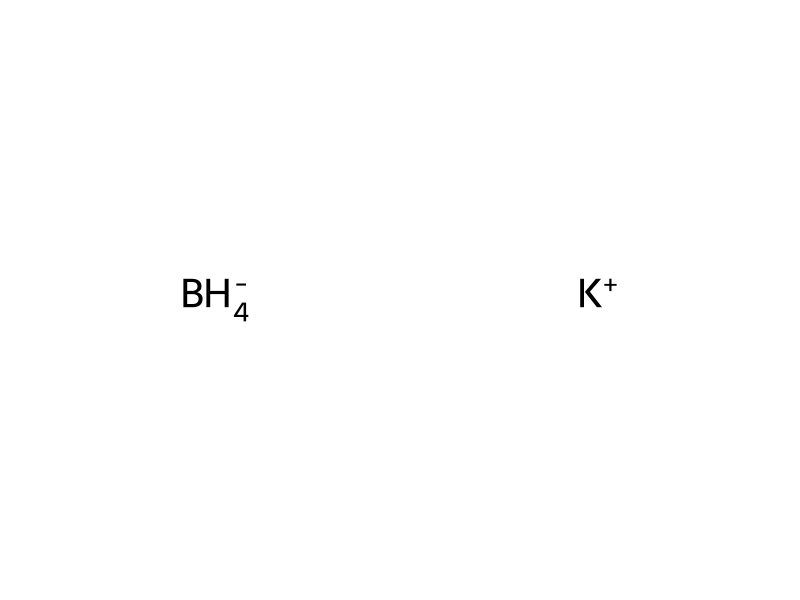
Potassium borohydride → HCID 23458676, compound
Reaction equation

[Cl:1][C:2]1[CH:3]=[CH:4][C:5]([NH:8][C:9](=[S:16])[S:10][CH2:11][CH2:12][C:13](=[O:15])[CH3:14])=[N:6][CH:7]=1.[BH4-].[K+]>CO.O.C(Cl)(Cl)Cl>[Cl:1][C:2]1[CH:3]=[CH:4][C:5]([NH:8][C:9](=[S:16])[S:10][CH2:11][CH2:12][CH:13]([OH:15])[CH3:14])=[N:6][CH:7]=1Participants





Procedure
The procedure of Example 3 is followed, but a suspension of 3-oxobutyl 5-chloropyrid-2-yldithiocarbamate (17.5 g) in methanol (220 cc) and a solution of potassium borohydride (3.44 g) in distilled water (55 cc) are used as the starting materials at a maximum of 30° C. The reaction is allowed to proceed for 1 hour at between 20° and 30° C. The resulting product (14.2 g; m.p.=115° C.) is dissolved in chloroform (500 cc). The solution is chromatographed on silica (0.2-0.5 mm) (140 g) contained in a column of diameter 3.4 cm. Elution is carried out with chloroform (1,500 cc), this eluate being discarded, and then with chloroform (4 liters). The eluate which is collected is evaporated to dryness under reduced pressure (20 mm Hg) at 45° C. The chromatographed product (11.4 g) is recrystallised from acetonitrile (85 cc). 3-Hydroxybutyl 5-chloropyrid-2-yldithiocarbamate (11.0 g), which melts at 122° C., is obtained.
Workup
- customare used as the starting materials at a maximum of 30° C
- customThe solution is chromatographed on silica (0.2-0.5 mm) (140 g)
- washElution
- customThe eluate which is collected
- customis evaporated to dryness under reduced pressure (20 mm Hg) at 45° C
- customThe chromatographed product (11.4 g) is recrystallised from acetonitrile (85 cc)
Sources & evidence
- ORD record
- ord-564aa2bdbc084dd891affd16bc731163
- Source dataset
- uspto-grants-1981_06
- Patent number
- US04271167
Reaction notes
Loading…