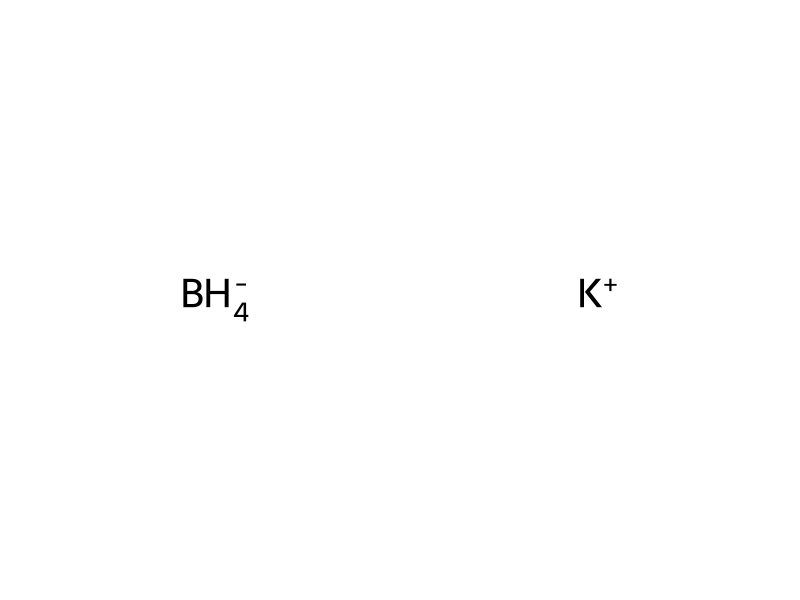
Potassium borohydride → HCID 23458670, compound
Reaction equation

[N:1]1[CH:6]=[CH:5][CH:4]=[CH:3][C:2]=1[N:7]1[C:12](=[O:13])[CH2:11][CH2:10][S:9][C:8]1=[S:14].[BH4-].[K+]>CO.O>[N:1]1[CH:6]=[CH:5][CH:4]=[CH:3][C:2]=1[NH:7][C:8](=[S:14])[S:9][CH2:10][CH2:11][CH2:12][OH:13]Participants
Reactant 2

Product 1

Reagents, catalysts & solvents 2


Procedure
The procedure of Example 24 is followed, but a suspension of 3-(pyrid-2-yl)-2-thioxo-perhydro-1,3-thiazin-4-one (22.4 g) in methanol (300 cc) and a solution of potassium borohydride (10.8 g) in distilled water (75 cc) are used as the starting materials at a maximum of 40° C. The reaction is allowed to proceed for 1 hour at between 25° and 40° C. The reaction mixture is evaporated to dryness and the residue (21.5 g) is dissolved in a mixture of ethyl acetate (70 cc) and cyclohexane (30 cc). The solution is chromatographed on silica (0.2-0.5 mm) (300 g) distributed in a column of diameter 4.5 cm. Elution is carried out with a mixture of ethyl acetate (520 cc) and cyclohexane (180 cc), this eluate being discarded, and then with a mixture of ethyl acetate (1,660 cc) and cyclohexane (540 cc). The eluate which is collected is evaporated to dryness under reduced pressure (20 mm Hg) at 45° C. 3-Hydroxypropyl pyrid-2-yldithiocarbamate (12.2 g), which melts at 93° C., is obtained.
Workup
- customare used as the starting materials at a maximum of 40° C
- customThe reaction mixture is evaporated to dryness
- dissolutionthe residue (21.5 g) is dissolved in a mixture of ethyl acetate (70 cc) and cyclohexane (30 cc)
- customThe solution is chromatographed on silica (0.2-0.5 mm) (300 g)
- washElution
- additionis carried out with a mixture of ethyl acetate (520 cc) and cyclohexane (180 cc)
- additionwith a mixture of ethyl acetate (1,660 cc) and cyclohexane (540 cc)
- customThe eluate which is collected
- customis evaporated to dryness under reduced pressure (20 mm Hg) at 45° C
Sources & evidence
- ORD record
- ord-31d88b5dac7447bdb0b8161cf4f1b07d
- Source dataset
- uspto-grants-1981_06
- Patent number
- US04271167
Reaction notes
Loading…