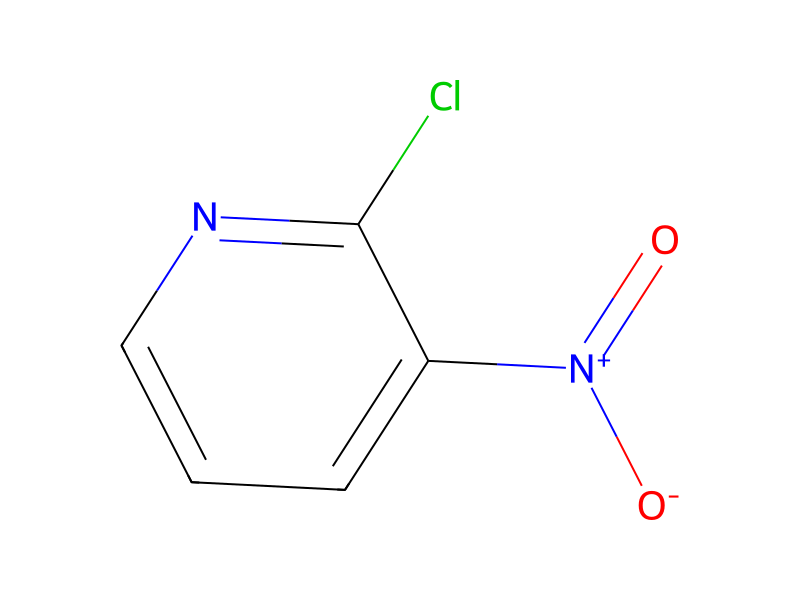
2-Chloro-3-nitropyridine → 2-Isothiocyanato-3-nitropyridine
Reaction equation

Cl[C:2]1[C:7]([N+:8]([O-:10])=[O:9])=[CH:6][CH:5]=[CH:4][N:3]=1.[N-:11]=[C:12]=[S:13].[K+]>C(O)(=O)C>[N:11]([C:2]1[C:7]([N+:8]([O-:10])=[O:9])=[CH:6][CH:5]=[CH:4][N:3]=1)=[C:12]=[S:13]Participants
4
Reactant 2

Product 1

Reagents, catalysts & solvents 1

Procedure
A 10 g sample of 2-chloro-3-nitropyridine, an 8 g sample of potassium isothiocyanate, and 75 ml of acetic acid were combined and refluxed for 2 h. The reaction mixture was then cooled and poured into 400 ml of ice/H2O. The resulting solid was washed with water, redissolved in ethyl acetate and washed (4x) with water. The ethyl acetate solution was then treated with activated carbon, dried over anhydrous Na2SO4, filtered and evaporated to dryness to provide 3.72 g of the title compound. m.p.=115°-118° C.
Workup
- temperaturerefluxed for 2 h
- temperatureThe reaction mixture was then cooled
- washThe resulting solid was washed with water
- dissolutionredissolved in ethyl acetate
- washwashed (4x) with water
- additionThe ethyl acetate solution was then treated with activated carbon
- dry with materialdried over anhydrous Na2SO4
- filtrationfiltered
- customevaporated to dryness
Sources & evidence
- ORD record
- ord-599fcb0d50864e0d9e66df83ef4a6b63
- Source dataset
- uspto-grants-1997_06
- Patent number
- US05637693
Reaction notes
Loading…