3,4-dihydro-2H-pyran → 2-(4-(chloromethyl)benzyloxy)tetrahydro-2H-pyran
Reaction equation

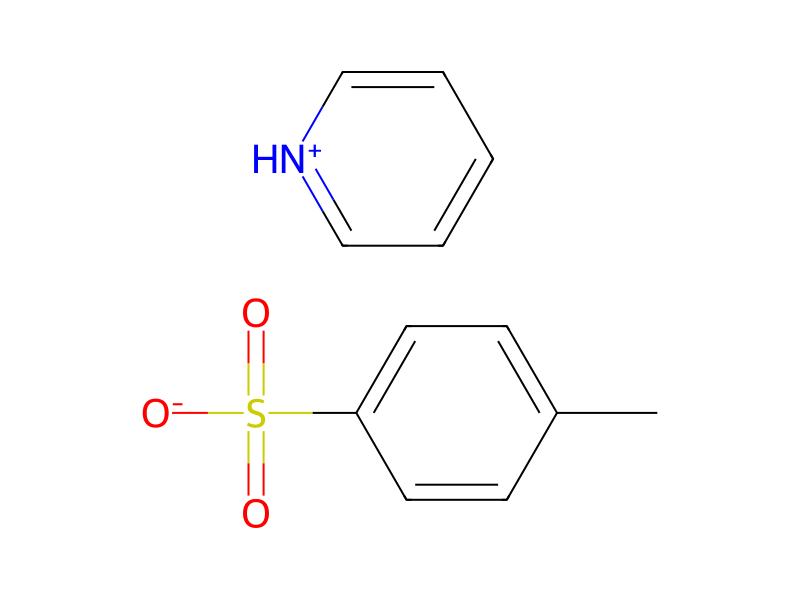
[OH:1][CH2:2][C:3]1[CH:10]=[CH:9][C:6]([CH2:7][Cl:8])=[CH:5][CH:4]=1.[O:11]1[CH:16]=[CH:15][CH2:14][CH2:13][CH2:12]1>ClCCl.C1(C)C=CC(S([O-])(=O)=O)=CC=1.[NH+]1C=CC=CC=1>[O:11]1[CH2:16][CH2:15][CH2:14][CH2:13][CH:12]1[O:1][CH2:2][C:3]1[CH:10]=[CH:9][C:6]([CH2:7][Cl:8])=[CH:5][CH:4]=1Participants
Reactant 2


Product 1

Reagents, catalysts & solvents 2

Conditions
- Temperature
- 5 °C
Procedure
p-Hydroxymethylbenzyl chloride (1.33 kg, 1 mole) in dichloromethane (6 liters) was charged to a 10 liter Morton flask. Addition of 3,4-dihydro-2H-pyran (925 g, 1.1 moles) to the flask was followed by cooling to 5° C. Pyridinium p-toluenesulfonate (1.25 g, 5 mmoles) was added as a catalyst. The contents were allowed to warm up to 20°-25° C. and stirred for 24 hours. The contents were washed with water followed by a sodium bicarbonate solution and then dried over anhydrous magnesium sulfate. The residue, after removal of solvent, was kept under high vacuum (1-2 mm Hg) for 24 hours and provided 2.28 kg (95% yield) of the desired product. 1H NMR spectral data were as follows: (CDCl3, 300 MHz): δ7.4 (s, 4H), 4.75 (t, 1H), 4.65 (AB quartet, 2H, J=13 Hz), 4.6 (s, 2H), 3.85 (m, 1H), 3.55 (m, 1H), 1.5-1.95 (m, 6H).
Workup
- temperatureto warm up to 20°-25° C.
- washThe contents were washed with water
- dry with materialdried over anhydrous magnesium sulfate
- customThe residue, after removal of solvent
- waitwas kept under high vacuum (1-2 mm Hg) for 24 hours
Sources & evidence
- ORD record
- ord-0ee2d55089b94b10a5b5d5b0ea41373e
- Source dataset
- uspto-grants-1997_06
- Patent number
- US05637780
Reaction notes
Loading…