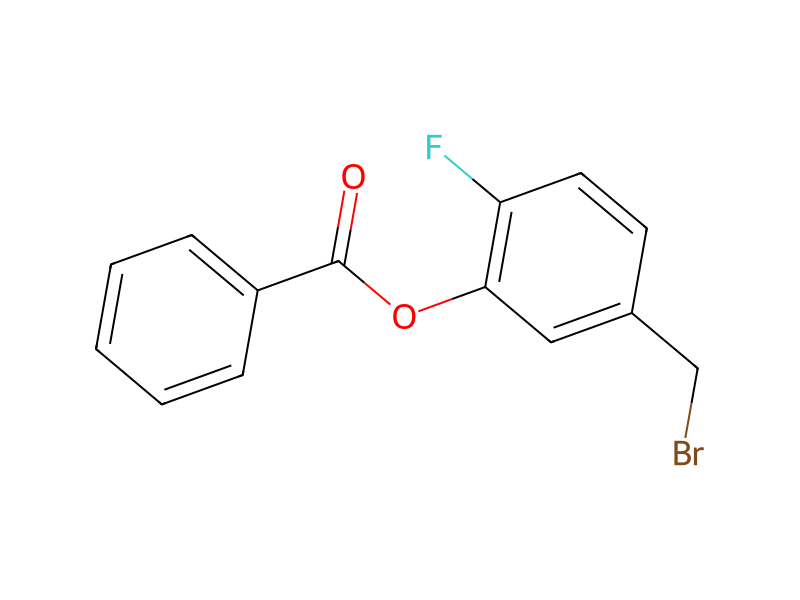
N-bromobutanimide → 3-Benzoyloxy-4-fluorobenzyl bromide
Reaction equation

[C:1]([O:9][C:10]1[CH:11]=[C:12]([CH3:17])[CH:13]=[CH:14][C:15]=1[F:16])(=[O:8])[C:2]1[CH:7]=[CH:6][CH:5]=[CH:4][CH:3]=1.[Br:18]N1C(=O)CCC1=O>C(Cl)(Cl)(Cl)Cl.CCOCC.O.C(OOC(=O)C1C=CC=CC=1)(=O)C1C=CC=CC=1>[C:1]([O:9][C:10]1[CH:11]=[C:12]([CH:13]=[CH:14][C:15]=1[F:16])[CH2:17][Br:18])(=[O:8])[C:2]1[CH:7]=[CH:6][CH:5]=[CH:4][CH:3]=1Participants






Procedure
Commercial N-bromosuccinimide (NBS) was recrystallised from water and thoroughly dried in vacuo (24 h) prior to use (mp. 180-182° C., lit. 180-183° C.). To a solution of 3-benzoyloxy-4-fluorotoluene (2.47 g, 10 mmol) in anhydrous carbon tetrachloride (25 mL) was added finely powdered NBS (1.96 g, 11 mmol) and benzoylperoxide (0.01 g). The mixture heated at reflux for 2 h, cooled and diluted with Et2O (100 mL) and water (50 mL). The ethereal layer was washed with brine (20 mL) and dried (Na2SO4). Concetration in vacuo and subsequent purification by flash column chromatography [SiO2, EtOAc/n-hexane (1:25)] gave 3-benzoyloxy-4-fluorobenzyl bromide as a white solid (1.80 g, 58%); δH (400 MHz, CDCl3) 4.48 (s, 2H), 7.18 (dd, J=9.8, 8.6, 1H), 7.28 (ddd, J=8.6, 4.3, 2.3, 1H), 7.34 (dd, J=7.0, 2.3, 1H), 7.50-7.55 (m, 2H), 7.64-7.69 (m, 1H), 8.18-8.23 (m, 2H); LRMS (FAB+) m/z (rel. intensity) 229.1 (95), 309.0 (100, [M+H]+). Found: C, 54.1, H, 3.22; C14H10BrFO2 requires C, 54.39, H, 3.26%.
Workup
- customCommercial N-bromosuccinimide (NBS) was recrystallised from water
- customthoroughly dried in vacuo (24 h)
- custom(mp. 180-182° C., lit. 180-183° C.)
- temperatureThe mixture heated
- temperatureat reflux for 2 h
- temperaturecooled
- washThe ethereal layer was washed with brine (20 mL)
- dry with materialdried (Na2SO4)
- customConcetration in vacuo and subsequent purification by flash column chromatography [SiO2, EtOAc/n-hexane (1:25)]
Sources & evidence
- ORD record
- ord-54d0fc5ada3c4e77930bb4c69e88d1f7
- Source dataset
- uspto-grants-2012_04
- Patent number
- US08148415B2
Reaction notes
Loading…