Triphenylphosphine → (S)-2-azido-3-(hexadecyloxy)propan-1-ol
Reaction equation

[CH2:1]([O:17][CH2:18][C@H:19](O)[CH2:20][OH:21])[CH2:2][CH2:3][CH2:4][CH2:5][CH2:6][CH2:7][CH2:8][CH2:9][CH2:10][CH2:11][CH2:12][CH2:13][CH2:14][CH2:15][CH3:16].C1C=CC(P(C2C=CC=CC=2)C2C=CC=CC=2)=CC=1.N(C(OC(C)C)=O)=NC(OC(C)C)=O.[Si]([N:60]=[N+:61]=[N-:62])(C)(C)C>C(Cl)Cl>[N:60]([C@H:19]([CH2:18][O:17][CH2:1][CH2:2][CH2:3][CH2:4][CH2:5][CH2:6][CH2:7][CH2:8][CH2:9][CH2:10][CH2:11][CH2:12][CH2:13][CH2:14][CH2:15][CH3:16])[CH2:20][OH:21])=[N+:61]=[N-:62]Participants


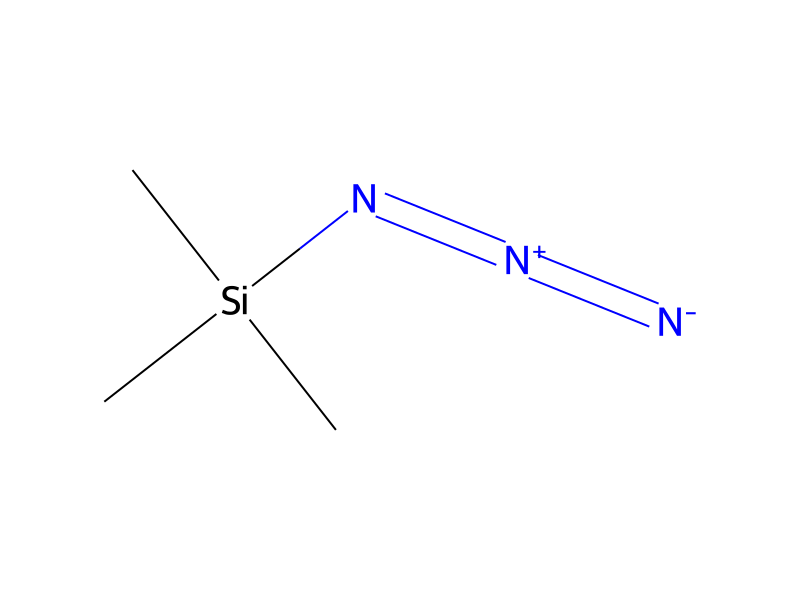



Procedure
To a solution of 3.17 g (10.0 mmol) of 3-O-hexadecyl-sn-glycerol (2) and 3.42 g (13.0 mmol) of Ph3P in 180 mL of CH2Cl2 was added 3.2 mL (15 mmol) of diisopropyl azodicarboxylate (DIAD) at 0° C. After the mixture was stirred for 3 h under nitrogen, Me3SiN3 was added. The mixture was stirred at the same temperature for 3 h, and then at room temperature until glycerol 2 had reacted completely. The reaction mixture was concentrated to give a yellow residue, which was dissolved in a minimum volume of CH2Cl2 and passed through a pad of silica gel in a sintered glass funnel. The pad was rinsed with hexane/EtOAc (50:1) until the excess yellow DIAD began to elute. After concentration of the eluted silyloxy azide, the residue was dissolved in 30 mL of THF and treated with 25 mL of a 1 M (n-Bu)4NF solution in THF. The mixture was stirred at room temperature until all of the silyloxy azides were consumed completely, and then was diluted with 250 mL of Et2O and washed with water and brine. The organic layer was separated, dried over Na2SO4, and concentrated The crude product was purified by column chromatography on silica gel (elution first 150 mL of 50:1 hexane/EtOAc and then with 6:1 hexane/EtOAc) to give 2.60 (76%) of azido alcohol 3 as a white solid: mp 37-39° C., (Ponpipom and Bugianesi, 1984). 38-29° C.; [α]25D +14.50 (c 1.0, CHCl3), (Ponpipom and Bugianesi 1984. [α]27D +14.1° (c 1.0, CHCl3); 1H NMR (CDCl3) δ 0.88 (t, 3H, J=6.4 Hz), 1.26 (s, 26H), 1.52-1.62 (m, 2H), 2.19 (br s, 1H), 3.47 (t, 2H, J=6.8 Hz), 3.55-3.63 (m, 4H), 3.65-3.80 (m, 1H); 13C NMR (CDCl3) δ 14.1, 22.7, 26.0, 29.3, 29.4, 29.5, 29.6, 29.7, 31.9, 62.3, 63.0, 70.9, 71.9.
Workup
- stirringThe mixture was stirred at the same temperature for 3 h
- concentrationThe reaction mixture was concentrated
- customto give a yellow residue, which
- custompassed through a pad of silica gel in a sintered glass funnel
- washThe pad was rinsed with hexane/EtOAc (50:1) until the excess yellow DIAD
- washto elute
- dissolutionAfter concentration of the eluted silyloxy azide, the residue was dissolved in 30 mL of THF
- additiontreated with 25 mL of a 1 M (n-Bu)4NF solution in THF
- stirringThe mixture was stirred at room temperature until all of the silyloxy azides
- customwere consumed completely
- additionwas diluted with 250 mL of Et2O
- washwashed with water and brine
- customThe organic layer was separated
- dry with materialdried over Na2SO4
- concentrationconcentrated The crude product
- customwas purified by column chromatography on silica gel (
- washelution first 150 mL of 50:1 hexane/EtOAc
Sources & evidence
- ORD record
- ord-4147ea35ad434bb1923c5f80fb3d4b19
- Source dataset
- uspto-grants-2012_04
- Patent number
- US08153615B2
Reaction notes
Loading…