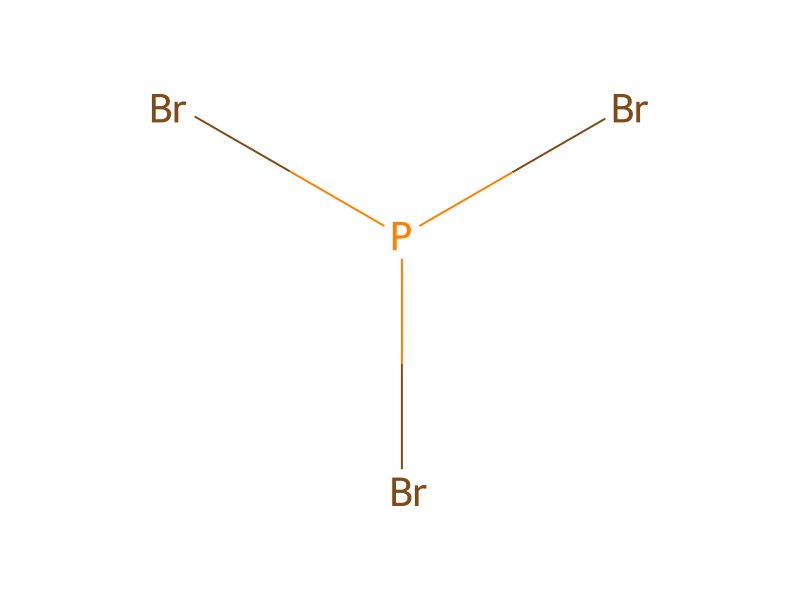
Phosphorus tribromide → 4-(Bromomethyl)-5-cyclopropyl-3-(2,6-dichlorophenyl)isoxazole
Reaction equation

[CH:1]1([C:4]2[O:8][N:7]=[C:6]([C:9]3[C:14]([Cl:15])=[CH:13][CH:12]=[CH:11][C:10]=3[Cl:16])[C:5]=2[CH2:17]O)[CH2:3][CH2:2]1.P(Br)(Br)[Br:20]>ClCCl>[Br:20][CH2:17][C:5]1[C:6]([C:9]2[C:14]([Cl:15])=[CH:13][CH:12]=[CH:11][C:10]=2[Cl:16])=[N:7][O:8][C:4]=1[CH:1]1[CH2:3][CH2:2]1Participants
4



Procedure
To a 0° C. solution of (5-cyclopropyl-3-(2,6-dichloro-phenyl)-isoxazol-4-yl)-methanol (0.124 g, 0.44 mmol) in dichloromethane (4 mL) is added phosphorous tribromide (0.261 g, 0.963 mmol). The ice bath is removed after 20 minutes and the reaction is allowed to stir for an additional twenty minutes at room temperature. The reaction is quenched with pH 7 buffer and is extracted with dichloromethane several times. The organic layers are combined, washed with brine, and dried over sodium sulfate. The reaction is filtered and concentrated under reduced pressure to yield the title compound (0.124 g, 82%). 1H-NMR (400 MHz CDCl3) δ 7.45-7.33 (m, 3H), 4.20 (s, 2H), 2.09 (m, 1H), 1.27 (m, 2H), 1.16 (m, 2H)
Workup
- customThe ice bath is removed after 20 minutes
- customThe reaction is quenched with pH 7 buffer
- extractionis extracted with dichloromethane several times
- washwashed with brine
- dry with materialdried over sodium sulfate
- filtrationThe reaction is filtered
- concentrationconcentrated under reduced pressure
Sources & evidence
- ORD record
- ord-7f02df043e864b08a0ead16e08e6f656
- Source dataset
- uspto-grants-2012_04
- Patent number
- US08153624B2
Reaction notes
Loading…