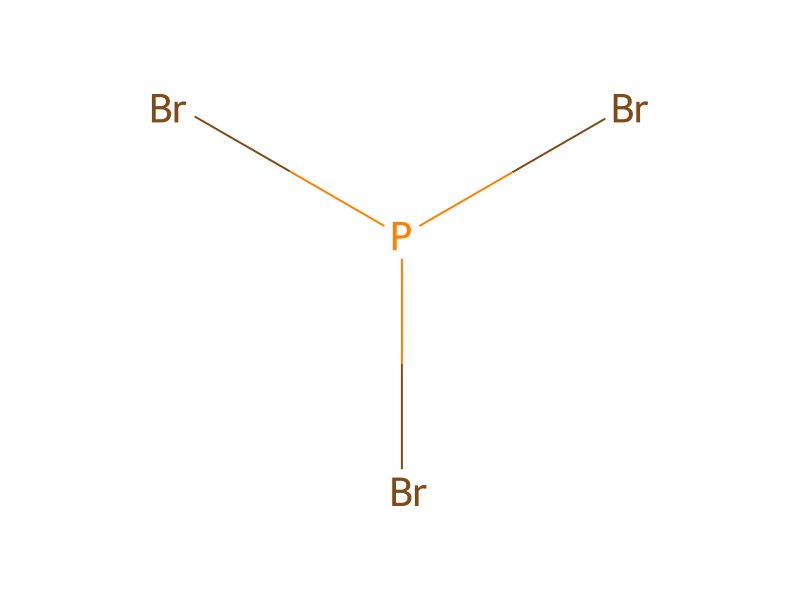
Phosphorus tribromide → 4-(Bromomethyl)-5-cyclopropyl-3-[2-(trifluoromethoxy)phenyl]isoxazole
Reaction equation

[CH:1]1([C:4]2[O:8][N:7]=[C:6]([C:9]3[CH:14]=[CH:13][CH:12]=[CH:11][C:10]=3[O:15][C:16]([F:19])([F:18])[F:17])[C:5]=2[CH2:20]O)[CH2:3][CH2:2]1.P(Br)(Br)[Br:23]>C(Cl)Cl>[Br:23][CH2:20][C:5]1[C:6]([C:9]2[CH:14]=[CH:13][CH:12]=[CH:11][C:10]=2[O:15][C:16]([F:19])([F:18])[F:17])=[N:7][O:8][C:4]=1[CH:1]1[CH2:3][CH2:2]1Participants
4



Procedure
To a solution of (5-cyclopropyl-3-(2-trifluormethoxy-phenyl)-isoxazol-4-yl)-methanol (2.19 g, 7.32 mmol) in anhydrous methylene chloride (50 mL) at 0° C. is added PBr3 (0.83 mL, 8.7 mmol) and the mixture is stirred for 3 hours. The mixture is then poured into 100 mL of ice water and extracted with DCM (2×). The combined DCM layers are washed with brine, dried (MgSO4) and concentrated under reduced pressure to provide crude residue. The residue is purified via flash chromatography (120 g silica) eluting with a gradient of 0 to 60% ethyl acetate in heptane to provide the title compound (2.1 g, 79%) as an oil.
Workup
- extractionextracted with DCM (2×)
- washThe combined DCM layers are washed with brine
- dry with materialdried (MgSO4)
- concentrationconcentrated under reduced pressure
- customto provide crude residue
- customThe residue is purified via flash chromatography (120 g silica)
- washeluting with a gradient of 0 to 60% ethyl acetate in heptane
Sources & evidence
- ORD record
- ord-9e84e084dab048989fc9b75c1dabbf71
- Source dataset
- uspto-grants-2012_04
- Patent number
- US08153624B2
Reaction notes
Loading…