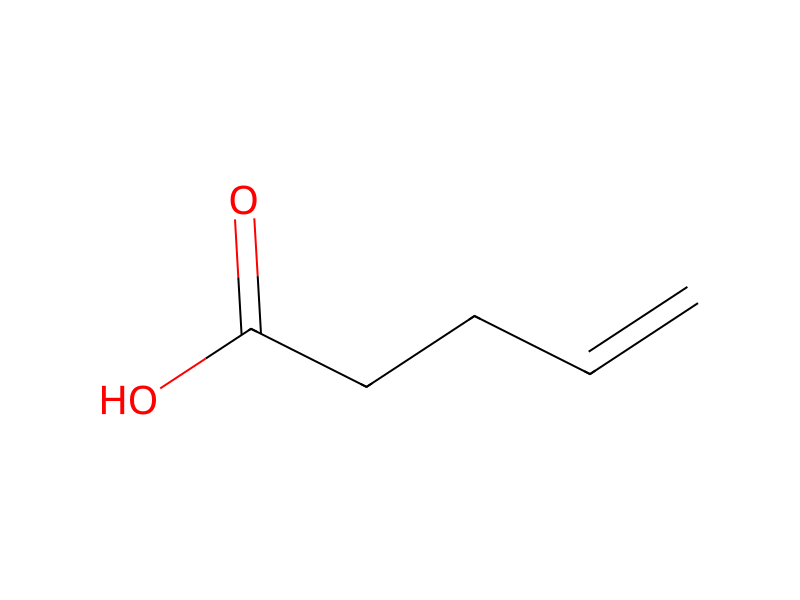
4-Pentenoic acid → HCID 86636726, compound
Reaction equation

[CH2:1]([P:9]([CH2:19][CH2:20][CH2:21][CH2:22][C:23]([O:25]C(=O)CCCCP(CCCCCCCC)(CCCCCCCC)=O)=[O:24])([CH2:11][CH2:12][CH2:13][CH2:14][CH2:15][CH2:16][CH2:17][CH3:18])=[O:10])[CH2:2][CH2:3][CH2:4][CH2:5][CH2:6][CH2:7][CH3:8].P([O-])(OCCCC)(OCCCC)=O.C([Mg]I)CCCCCCC.C(O)(=O)CCC=C>>[CH2:1]([P:9]([CH2:19][CH2:20][CH2:21][CH2:22][C:23]([OH:25])=[O:24])([CH2:11][CH2:12][CH2:13][CH2:14][CH2:15][CH2:16][CH2:17][CH3:18])=[O:10])[CH2:2][CH2:3][CH2:4][CH2:5][CH2:6][CH2:7][CH3:8]Participants
5


Procedure
In a similar vein, hybrid dispersing agents were designed for CdSe nanoparticles and in this case, phosphine oxide chain ends were required for interaction with the surface of the CdSe. Using an anhydride functionalization approach requires 5-(dioctylphosphoryl)pentanoic anhydride, 13, which was synthesized by initial alkylation of di-n-butyl phosphate, 14, with octylmagnesium iodide followed by reaction with 4-pentenoic acid using AlBN to give 5-(dioctylphosphoryl)pentanoic acid, 15, which was converted into the desired anhydride, 13, using DCC (See FIG. 9). The anhydride was then used to functionalize the chain ends of 9a to give the phosphine oxide functionalized dendritic-linear copolymer, 16 (See FIG. 10).
Workup
- additionIn a similar vein, hybrid dispersing agents
Sources & evidence
- ORD record
- ord-957e702899d74f0b989b9243c2392d4a
- Source dataset
- uspto-grants-2012_04
- Patent number
- US08153729B2
Reaction notes
Loading…