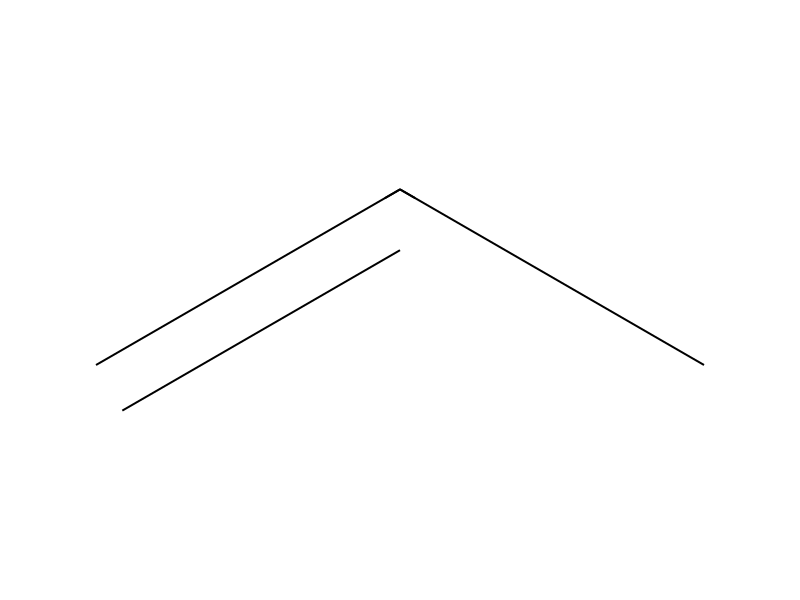
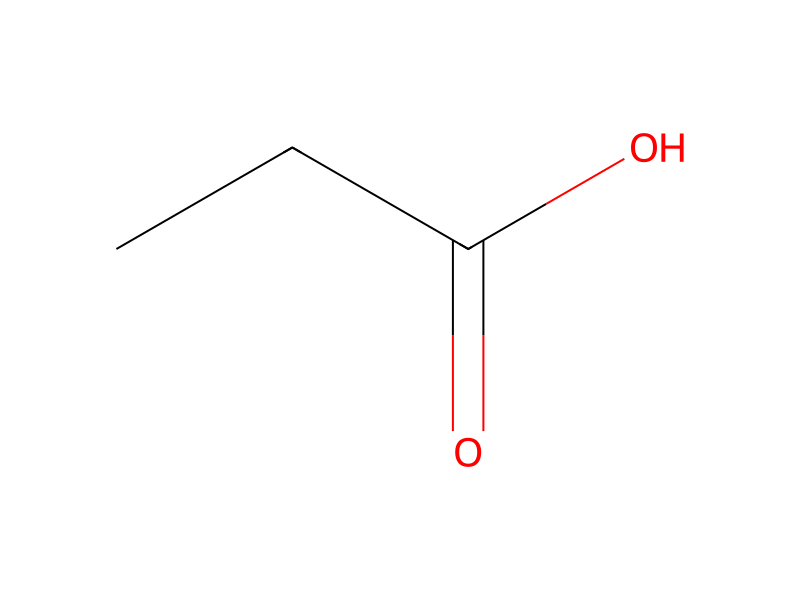
Propylene → Propionic Acid
Reaction equation

C=CC.[CH3:4][CH2:5][C:6]([O:8]O)=[O:7]>>[CH2:6]1[O:8][CH:5]1[CH3:4].[C:6]([OH:8])(=[O:7])[CH2:5][CH3:4]Participants


Procedure
The organic solution leaves the head of the acid back-wash column 103 by a line 118 and is taken to a multiplate contactor column 160 operating at -5° C., where, as explained later, it contacts unreacted propylene and dissolves it. The organic solution leaves the base of the contactor column 160 by a line 161 and is taken to a reactor 122 which is conveniently illustrated as a column, although in practice a long tubular reactor would be preferred. Propylene is also fed to this reactor by a line 123 from a storage vessel 124. It will be appreciated that under normal conditions of temperature and pressure, propylene is a gas and therefore the reactor 122 is operated under pressure in order that the propylene should be kept in solution in the organic solution. The propylene reacts with the perpropionic acid in the reactor 122 to give propylene oxide and propionic acid in accordance with step (e). This product mixture is taken by a line 162 to a first distillation column 163 and in this column all except a solution of propionic acid in propylene dichloride is distilled off as a light fraction. This light fraction is taken by a line 164 to a condenser 165 where it is cooled sufficiently for all except the propylene and propane to condense. This gas is taken by a line 166 from the condenser 165 back to the contactor 160 where the propylene is absorbed. Any propane is not absorbed and is passed out of the contactor 160 to waste by a line 167.
Workup
- customThe organic solution leaves the head of the acid
- washback-wash column 103 by a line 118
- customis taken to a multiplate contactor column 160 operating at -5° C.
- dissolutiondissolves it
- customThe organic solution leaves the base of the contactor column 160 by a line 161
- customis taken to a reactor
Sources & evidence
- ORD record
- ord-481c6e65d2ee439dbd9a7e9bbe6d2432
- Source dataset
- uspto-grants-1980_03
- Patent number
- US04193929
Reaction notes
Loading…