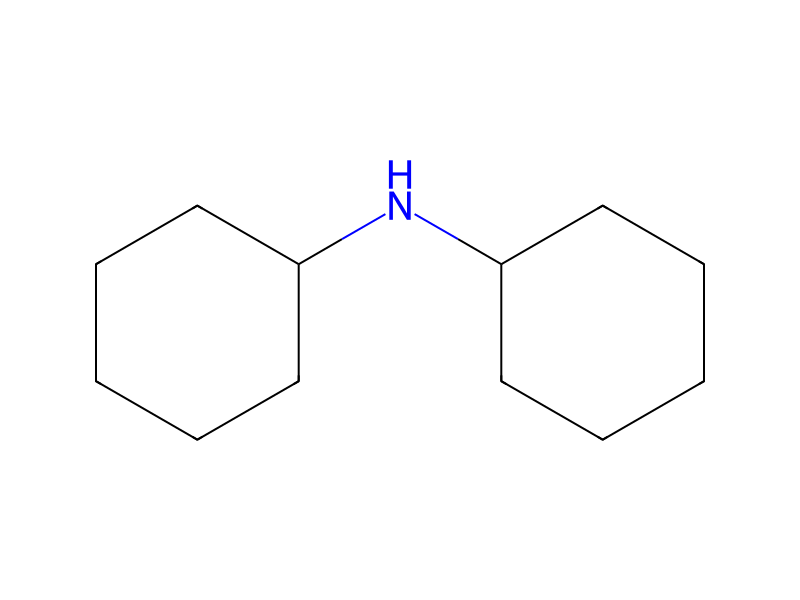
Dicyclohexylamine → HCID 13055364, compound
Reaction equation

O=C1C2C(=CC=CC=2)C(=O)[N:3]1[C@@H:12]([CH3:27])[C:13]([N:15]1[C:23]2[C:18](=[CH:19][CH:20]=[CH:21][CH:22]=2)[CH2:17][C@H:16]1[C:24]([OH:26])=[O:25])=[O:14].C1(NC2CCCCC2)CCCCC1.S(=O)(=O)(O)[O-].[K+].NN>CO>[NH2:3][C@@H:12]([CH3:27])[C:13]([N:15]1[C:23]2[C:18](=[CH:19][CH:20]=[CH:21][CH:22]=2)[CH2:17][C@H:16]1[C:24]([OH:26])=[O:25])=[O:14]Participants
Reactant 4



Product 1

Reagents, catalysts & solvents 1

Procedure
(S)-2,3-Dihydro-1-[(S)-2-(1,3-dihydro-1,3-dioxo-2H-isoindol-2-yl)-1-oxopropyl]-1H-indole-2-carboxylic acid, dicyclohexylamine (20.4 g.) was treated with 5% aqueous potassium bisulfate solution (300 ml.), and the free acid that formed was extracted three times with methylene chloride (combined extracts 450 ml.). The combined extracts were washed with saline twice, then dried over anhydrous sodium sulfate. Evaporation of the methylene chloride on a rotary evaporator under reduced pressure, then in high vacuum gave an amorphous solid which was dissolved in methanol (200 ml.). Hydrazine (95%, 1.43 g.) was added to the methanol solution. The resulting mixture was stirred under nitrogen atmosphere at room temperature for 24 hr., then chilled in an ice-salt mixture for 3 hr. A precipitate (phthalhydrazide, 4.06 g.) was collected on a filter, and washed with methanol. The combined filtrate and washings were evaporated on a rotary evaporator under reduced pressure, then in vacuo to give a solid residue. The residue was triturated with methylene chloride (ca. 250 ml.) and filtered. The filter residue was washed with methylene chloride several times and dried in vacuo. The crude product was dissolved in water (ca. 50 ml.) at room temperature, and filtered. The filter residue was washed with water. The combined filtrate and washings were evaporated carefully on a rotary evaporator under reduced pressure to give a solid residue which was dried over phosphorous pentoxide in vacuo to give the title product (6.31 g.), [α]D25 =-140.85 (c=1.44%, water). The analytical sample which was obtained by recrystallizations from methanol melted at 171°-172° (when the melting point was determined with rapid heating, the compound melted at 206.5°-209°), [α]D25 =-161.17° (c=1.065%, EtOH).
Workup
- customthe free acid that formed
- extractionwas extracted three times with methylene chloride (combined extracts 450 ml.)
- washThe combined extracts were washed with saline twice
- dry with materialdried over anhydrous sodium sulfate
- customEvaporation of the methylene chloride
- customon a rotary evaporator under reduced pressure
- customin high vacuum gave an amorphous solid which
- customA precipitate (phthalhydrazide, 4.06 g.) was collected on a filter
- washwashed with methanol
- customThe combined filtrate and washings were evaporated on a rotary evaporator under reduced pressure
- customin vacuo to give a solid residue
- customThe residue was triturated with methylene chloride (ca. 250 ml.)
- filtrationfiltered
- washThe filter residue was washed with methylene chloride several times
- customdried in vacuo
- dissolutionThe crude product was dissolved in water (ca. 50 ml.) at room temperature
- filtrationfiltered
- washThe filter residue was washed with water
- customThe combined filtrate and washings were evaporated carefully on a rotary evaporator under reduced pressure
- customto give a solid residue which
- dry with materialwas dried over phosphorous pentoxide in vacuo
Sources & evidence
- ORD record
- ord-ac18bd6759704ca2b3b9f6699de97891
- Source dataset
- uspto-grants-1982_09
- Patent number
- US04350633
Reaction notes
Loading…