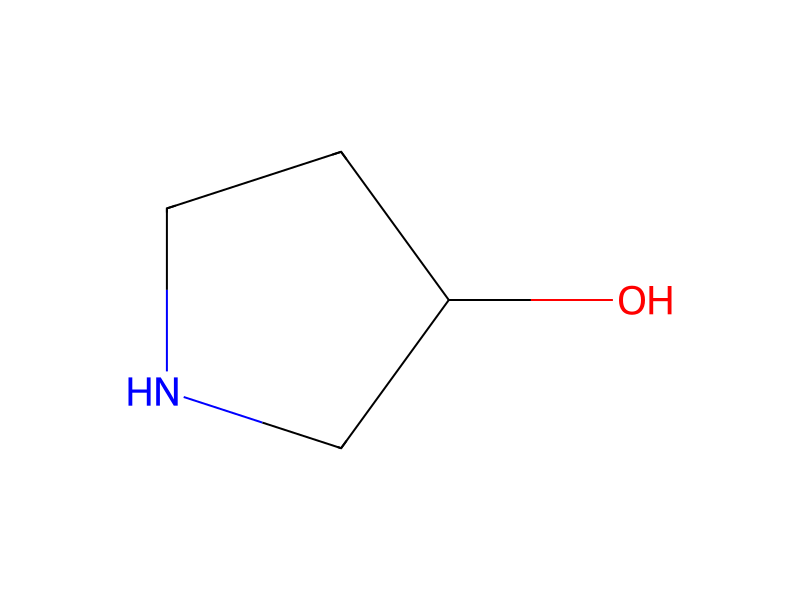
4-Hydroxypyrrolidine → HCID 20506397, compound
Reaction equation

[NH2:1][C:2]1[C:11]2[C:6](=[C:7]([O:15][CH3:16])[C:8]([O:13][CH3:14])=[C:9]([Cl:12])[CH:10]=2)[N:5]=[C:4](Cl)[N:3]=1.[NH:18]1[CH2:22][CH2:21][CH:20]([OH:23])[CH2:19]1>C(O)CC(C)C>[ClH:12].[OH:23][CH:20]1[CH2:21][CH2:22][N:18]([C:4]2[N:3]=[C:2]([NH2:1])[C:11]3[C:6](=[C:7]([O:15][CH3:16])[C:8]([O:13][CH3:14])=[C:9]([Cl:12])[CH:10]=3)[N:5]=2)[CH2:19]1Participants
4
Reactant 2

Product 1

Reagents, catalysts & solvents 1

Procedure
A mixture of 4-amino-2,6-dichloro-7,8-dimethoxyquinazoline (5.48 g., 0.020 mole) and 3-pyrrolidinol (2.18 g., 0.025 mole) in 150 ml. of isoamyl alcohol is heated at reflux for five hours then cooled in ice. The precipitated product is collected by filtration and purified by recrystallization to obtain the title compound.
Workup
- temperatureat reflux for five hours
- temperaturethen cooled in ice
- filtrationThe precipitated product is collected by filtration
- custompurified by recrystallization
Sources & evidence
- ORD record
- ord-b3ed801d88594bfdb7948281fa7e2502
- Source dataset
- uspto-grants-1982_09
- Patent number
- US04351940
Reaction notes
Loading…