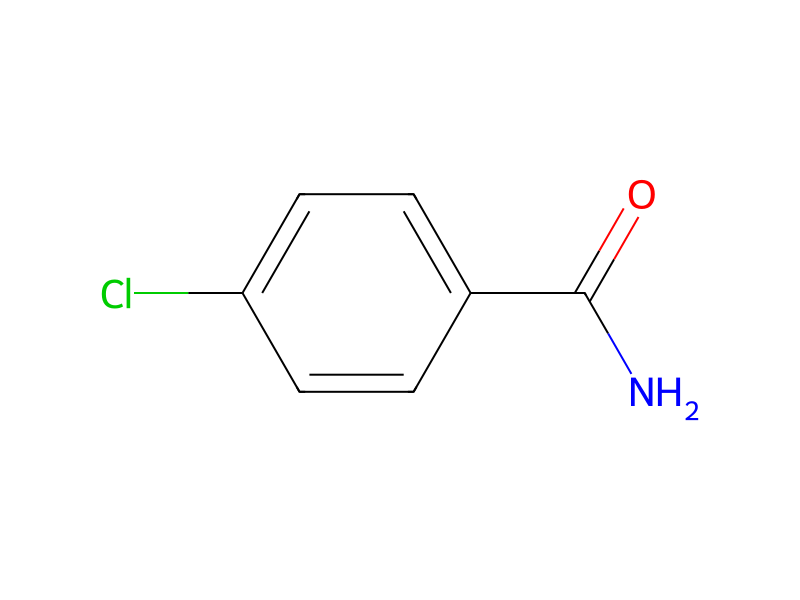
4-Chlorobenzamide → HCID 22761225, compound
Reaction equation

[C:1]([C:5]([CH:7]=[O:8])=[O:6])([CH3:4])([CH3:3])[CH3:2].[Cl:9][C:10]1[CH:18]=[CH:17][C:13]([C:14]([NH2:16])=[O:15])=[CH:12][CH:11]=1>C1C=CC=CC=1>[Cl:9][C:10]1[CH:18]=[CH:17][C:13]([C:14]([NH:16][CH:7]([OH:8])[C:5](=[O:6])[C:1]([CH3:4])([CH3:3])[CH3:2])=[O:15])=[CH:12][CH:11]=1Participants
4
Reactant 2

Product 1

Reagents, catalysts & solvents 1

Procedure
14 g (0.123 mol) of freshly distilled tert.-butylglyoxal were dissolved in 150 ml of absolute benzene. 19.1 g (0.123 mol) of p-chlorobenzamide were added and the mixture was heated for 15 hours under reflux. On cooling, the reaction product crystallised out. 16.1 g (54% of theory) of 1-(p-chlorobenzamido)-3,3-dimethyl-1-hydroxy-butan-2-one of melting point 130° C. were obtained.
Workup
- temperaturethe mixture was heated for 15 hours
- temperatureunder reflux
- temperatureOn cooling
- customthe reaction product crystallised out
Sources & evidence
- ORD record
- ord-f25c3edfbcd64ca7aa0a87f5e4bf8059
- Source dataset
- uspto-grants-1978_11
- Patent number
- US04124369
Reaction notes
Loading…