Sodium borohydride → HCID 53712702, compound
Reaction equation

[I-].[CH3:2][O:3][N:4]=[C:5]([C:8]1[CH:9]=[N+:10]([CH3:14])[CH:11]=[CH:12][CH:13]=1)[C:6]#[N:7].[BH4-].[Na+]>CO>[CH3:2][O:3][N:4]=[C:5]([C:8]1[CH2:9][N:10]([CH3:14])[CH2:11][CH2:12][CH:13]=1)[C:6]#[N:7]Participants
Reactant 2

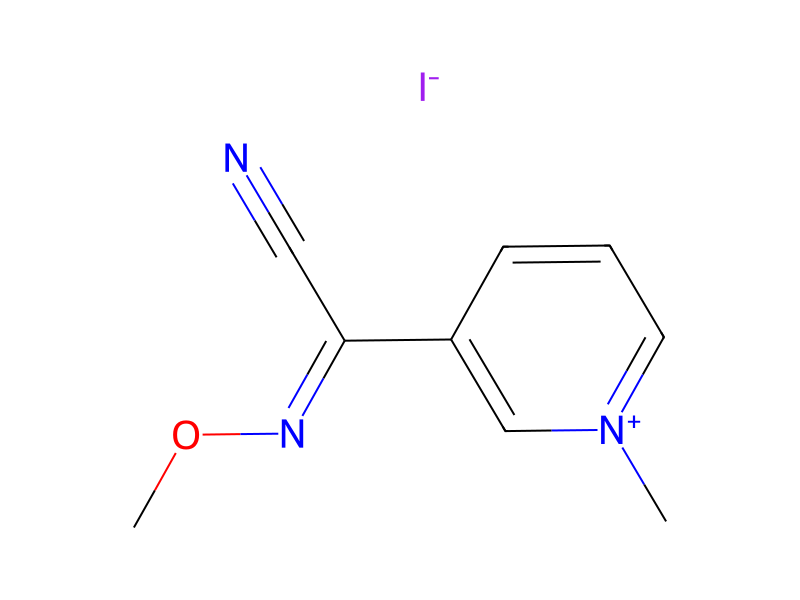
Product 1

Reagents, catalysts & solvents 1

Conditions
- Temperature
- 0 °C
Procedure
α-(Methoxyimino)-α-(1-methylpyridinium-3-yl)acetonitrile iodide (D6) (0.3 g, 0.001 mol) was dissolved in methanol (10 ml) and cooled to 0° C. Sodium borohydride (0.114 g, 0.003 mol) was added in three equal portions at 15 minute intervals. The mixture was allowed to warm to room temperature over 1 h and then evaporated to dryness. The residue was partitioned between saturated aqueous potassium carbonate solution (50 ml) and chloroform (3×75 ml). The organic layers were separated and dried (Na2SO4) then filtered and evaporated to dryness. The residue was subjected to column chromatography on silica gel eluting with 0-1% methanol/chloroform. This gave the title compound (D7) as an oil (0.04 g, 23%). A portion of this material was converted to the oxalate salt and crystallised from ethanol/diethyl ether to give a white crystalline solid m.p. 157°-158° C.
Workup
- temperatureto warm to room temperature over 1 h
- customevaporated to dryness
- customThe residue was partitioned between saturated aqueous potassium carbonate solution (50 ml) and chloroform (3×75 ml)
- customThe organic layers were separated
- dry with materialdried (Na2SO4)
- filtrationthen filtered
- customevaporated to dryness
Sources & evidence
- ORD record
- ord-d6ed3605e5b34833a41f9189d0cfe0df
- Source dataset
- uspto-grants-1994_10
- Patent number
- US05356914
Reaction notes
Loading…