Pyridine → 2-(4-Methoxybenzoyl)-4,4-diethylisoxazolidine-3,5-dione
Reaction equation

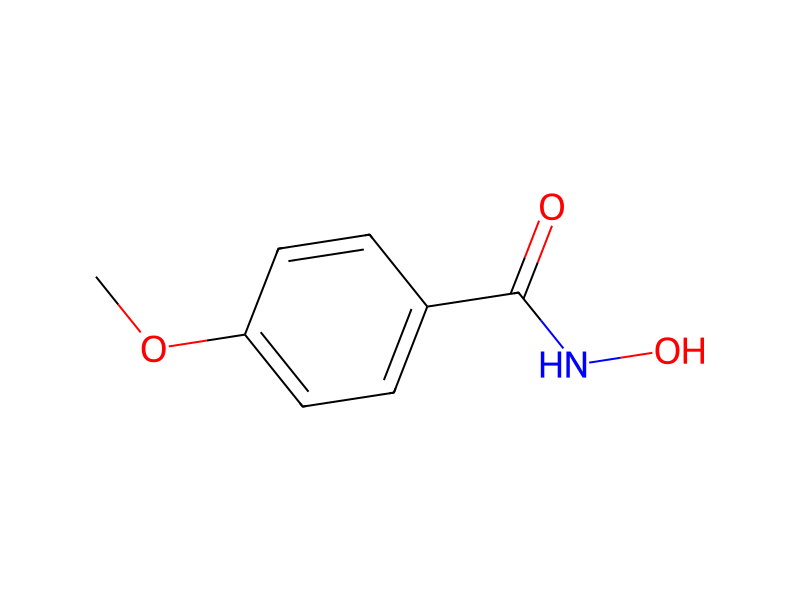
[CH3:1][O:2][C:3]1[CH:12]=[CH:11][C:6]([C:7]([NH:9][OH:10])=[O:8])=[CH:5][CH:4]=1.N1C=CC=CC=1.[CH2:19]([C:21]([CH2:28][CH3:29])([C:25](Cl)=[O:26])[C:22](Cl)=[O:23])[CH3:20]>C(Cl)Cl>[CH3:1][O:2][C:3]1[CH:4]=[CH:5][C:6]([C:7]([N:9]2[C:22](=[O:23])[C:21]([CH2:28][CH3:29])([CH2:19][CH3:20])[C:25](=[O:26])[O:10]2)=[O:8])=[CH:11][CH:12]=1Participants
Reactant 3


Product 1

Reagents, catalysts & solvents 1

Procedure
A mixture consisting of 1.67 g (0.0107 mol) of 4-methoxybenzohydroxamic acid, mp 158°-15920 C. (dec.)(lit. mp 156°-157° C. (dec.), Beilstein Handbook of Organic Chemistry, series H, vol 10, p. 170), 5 ml of pyridine, and 100 ml of methylene chloride was prepared in a 250 ml round bottom flask. The mixture was cooled in an ice bath, and 2.107 g (0.0107 mol) of diethylmalonyl chloride was added dropwise over a 15 minute period with stirring. The reaction mixture was stirred for 2 hours at room temperature after which time all the hydroxamic acid had dissolved. The solution was extracted two times with 50 ml portions of water, three times with 50 ml portions of 5% hydrochloric acid, and two times with 50 ml portions of 5% sodium carbonate. The methylene chloride was dried (MgSO4) and evaporated to dryness under reduced pressure to give 2.19 g (70.4%) of crude 2-(4-methoxybenzoyl)-4,4-diethylisoxazolidine-3,5-dione as a solid residue. Recrystallization of the solid from absolute ethanol gave pure 2-(4-methoxybenzoyl)-4,4-diethylisoxazolidine-3,5-dione as a white solid: mp 116°-118° C.; IR (Nujol) 1810 (s,C=O), 1750 (s, C=O), 1690 cm-1 (s, C=O); 1H NMR (400 MHz, CDCl3) 7.83 (d, 2H), 6.98 (d, 2H), 3.89 (t, 3H), 1.95 (q, 4H), 1.01 (t, 6H); High resolution MS, calc'd for: C15H17NO5 : 291.1102. Found: 291.1106. Anal. Calc' d for: C15H17NO5 : C, 61.84; H, 5.88; N, 4.81. Found: C, 61.83; H, 5.76; N, 4.76.
Workup
- temperatureThe mixture was cooled in an ice bath
- dissolutionhad dissolved
- extractionThe solution was extracted two times with 50 ml portions of water, three times with 50 ml portions of 5% hydrochloric acid, and two times with 50 ml portions of 5% sodium carbonate
- dry with materialThe methylene chloride was dried (MgSO4)
- customevaporated to dryness under reduced pressure
Sources & evidence
- ORD record
- ord-a80abc98edcf4730af0c2b79e350e6b8
- Source dataset
- uspto-grants-1990_08
- Patent number
- US04946963
Reaction notes
Loading…