1,3,5-Trinitrobenzene → 1,3,5-Triaminobenzene
反応式

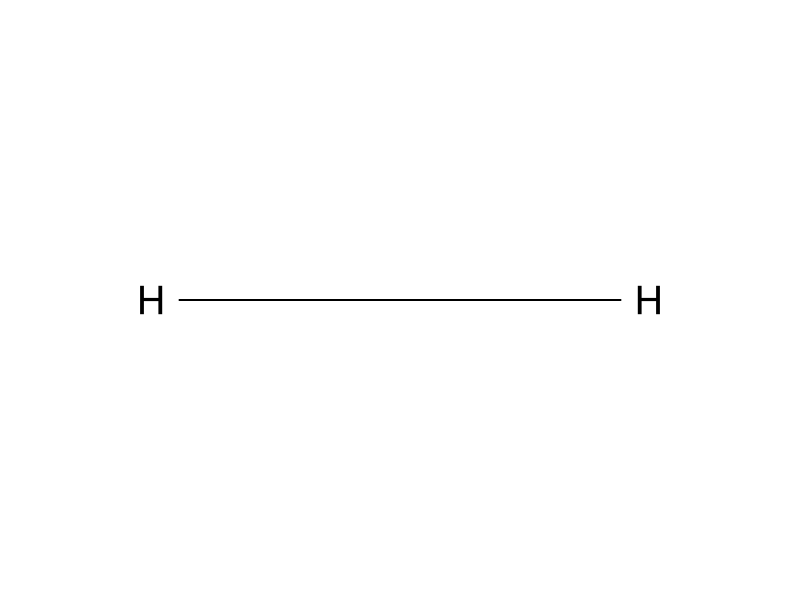
[N+:1]([C:4]1[CH:9]=[C:8]([N+:10]([O-])=O)[CH:7]=[C:6]([N+:13]([O-])=O)[CH:5]=1)([O-])=O.[N+](C1C=C(C=C([N+]([O-])=O)C=1)N)([O-])=O.NC1C=C([N+]([O-])=O)C=C(N)C=1.[H][H]>>[NH2:1][C:4]1[CH:9]=[C:8]([NH2:10])[CH:7]=[C:6]([NH2:13])[CH:5]=1参加物



実験手順
The compounds of the formula (I) can be synthesized e.g. by hydrogenation of 1,3,5-trinitrobenzene, 3,5-dinitroaniline or 1,3-diamino-5-nitrobenzene with hydrogen and an appropriate metal catalyst in an appropriate organic solvent. The thus obtained 1,3,5-triaminobenzene can be isolated or optionally transferred into the corresponding hydrochloride and can be purified in both forms by recrystallization from an appropriate solvent. It is also possible to use the solution of the crude trisamine or the isolated crude trisamine (with or without removal of the water formed in the hydrogenation) for the subsequent acylation reaction. Possible catalysts are e.g. Pd. PtO2, Raney-Nickel etc., preferably the commercially available versions on carbon support. The hydrogenation can be carried out under normal pressure or under pressure at temperatures between 20 and 120° C. (Safety checks are highly recommended before scale up). Appropriate solvents for the hydrogenation are e.g. tetrahydrofuran (THF), THF/methanol, dimethylformamide (DMF) or N-methylpyrrolidinone (NMP). An alternative procedure is reduction with Raney-Nickel and hydrazine as hydrogen source (see e.g. Organikum, chapter 8.1, Reduktion von Nitroverbindungen und Nitresoverbindung, Berlin, 1970) or other known standard reductions. Recrystallization can be carried out e.g. with methanol, ethanol or other alcohols. The free amine (or the amine obtained from the hydrochloride and an appropriate base) can be acylated with a stoichiometric amount or an excess of the corresponding acid chloride, preferably in the presence of an organic or inorganic non-interacting base e.g. triethylamine, tributylamine, pyridine; another method uses a stoichiometric amount or an excess of the anhydride of the carboxylic acid as acylating agent; in this case no base is required. The reaction is carried out in the absence or preferably in the presence of a solvent. The ideal reaction temperature depends on the nature of the acylating agents (e.g. 0°-100° C.). Isolation/purification of the final product is carried out by precipitation/recrystallization/washing with an appropriate mixture of water/organic solvent or organic solvent/organic solvent or with a pure solvent, e.g. DMF/water, NMP/water, ethanol, methanol etc.
出典と根拠
- ORDレコード
- ord-2280dd1cd8da4ae5895ab9f52ce1f3aa
- 出典データセット
- uspto-grants-2010_09
- 特許番号
- US07790793B2
反応ノート
読み込み中…