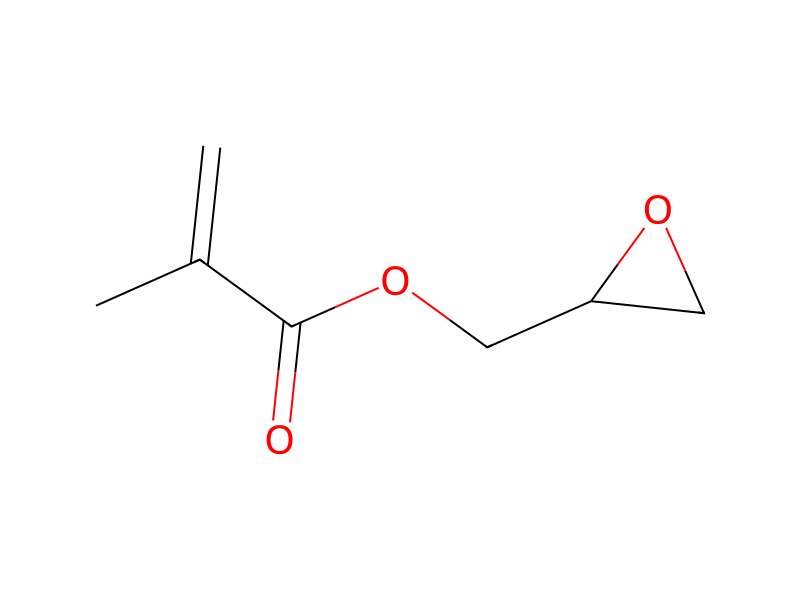
Acetone → Glycidyl methacrylate
Reaction equation

[C:1]([O:6][CH2:7][CH2:8][OH:9])(=[O:5])[C:2]([CH3:4])=[CH2:3].[CH3:10][C:11]([CH3:13])=[O:12]>>[C:1]([O:6][CH2:7][CH2:8][OH:9])(=[O:5])[C:2]([CH3:4])=[CH2:3].[C:1]([O:6][CH2:10][CH:11]1[O:12][CH2:13]1)(=[O:5])[C:2]([CH3:4])=[CH2:3]Participants


Procedure
A copolymer of 2-hydroxyethyl methacrylate (HEMA; the extra pure grade reagent, Wako Pure Chemical Industries, Ltd., Japan) and glycidyl methacrylate (GMA; Nacalai tesque, Ltd., Japan) was prepared as a polymer for coating as follows. First of all, those reagents were distilled under reduced pressure to remove the polymerization inhibitor (hydroxy monomethyl ether). Then, 12 mL of HEMA and 60 μL of GMA in 50 mL of ethanol were polymerized at 60° C. for ten hours in the presence of 400 mg of α,α′-azobisisobutyronitrile (polymerization initiator; Nacalai tesque, Ltd., Japan). The obtained GMA-HEMA copolymer was added dropwise into acetone to give spherical beads and collected by filtration. Then, the obtained beads were dried under reduced pressure and crushed using mill to prepare a powder of GMA-HEMA copolymer.
Workup
- custom, Japan) and glycidyl methacrylate (GMA; Nacalai tesque, Ltd., Japan) was prepared as a polymer for coating
- distillationFirst of all, those reagents were distilled under reduced pressure
- customto remove the polymerization inhibitor (hydroxy monomethyl ether)
- customto give spherical beads
- filtrationcollected by filtration
- customThen, the obtained beads were dried under reduced pressure
- customcrushed
- customto prepare a powder of GMA-HEMA copolymer
Sources & evidence
- ORD record
- ord-2ed1551da2df46d39efaa081528a242e
- Source dataset
- uspto-grants-2010_09
- Patent number
- US07795176B2
Reaction notes
Loading…