Acetic Anhydride → Acetoxy-(4-bromo-phenyl)-acetic acid
Reaction equation

[Br:1][C:2]1[CH:12]=[CH:11][C:5]([CH:6]([OH:10])[C:7]([OH:9])=[O:8])=[CH:4][CH:3]=1.[C:13](OC(=O)C)(=[O:15])[CH3:14]>N1C=CC=CC=1>[C:13]([O:10][CH:6]([C:5]1[CH:11]=[CH:12][C:2]([Br:1])=[CH:3][CH:4]=1)[C:7]([OH:9])=[O:8])(=[O:15])[CH3:14]Participants
4
Reactant 2

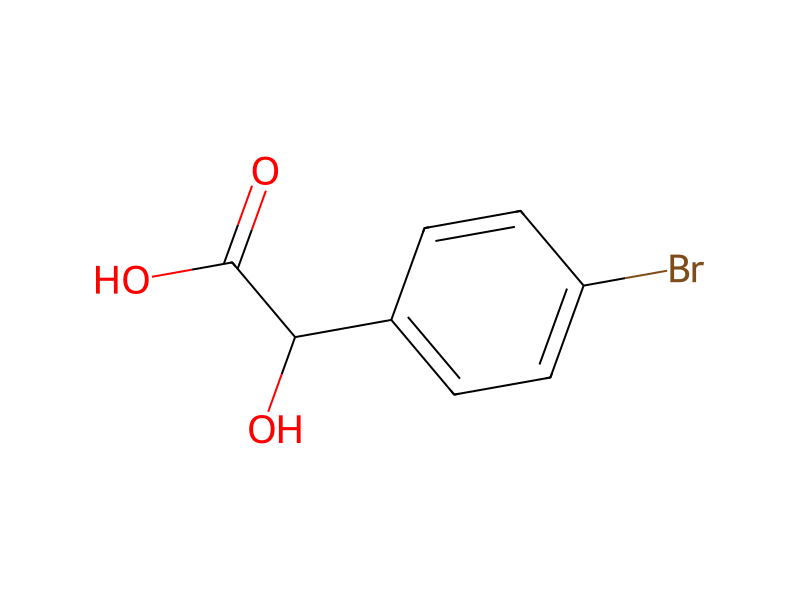
Product 1

Reagents, catalysts & solvents 1

Procedure
To a solution of 4-bromomandelic acid (20.6 g, 89.0 mmol) dissolved in pyridine (50 mL) was added acetic anhydride (10 g, 98 mmol) dropwise while cooling with an ice bath. After stirring overnight at room temperature, the solvent was removed and the resulting residue dissolved in ethyl acetate (150 mL). This was washed twice with 1N HCl, brine, and then concentrated in vacuo to obtain a white solid (18.2 g, 75%) which was used without further purification.
Workup
- temperaturewhile cooling with an ice bath
- customthe solvent was removed
- dissolutionthe resulting residue dissolved in ethyl acetate (150 mL)
- washThis was washed twice with 1N HCl, brine
- concentrationconcentrated in vacuo
Sources & evidence
- ORD record
- ord-962feb44c0c64c72be222d6733f89755
- Source dataset
- uspto-grants-2010_09
- Patent number
- US07795315B2
Reaction notes
Loading…