HuagongsheHuagongshe Chemistry Print Report · For research reference only
HRID 1715324Generated: October 29, 2026
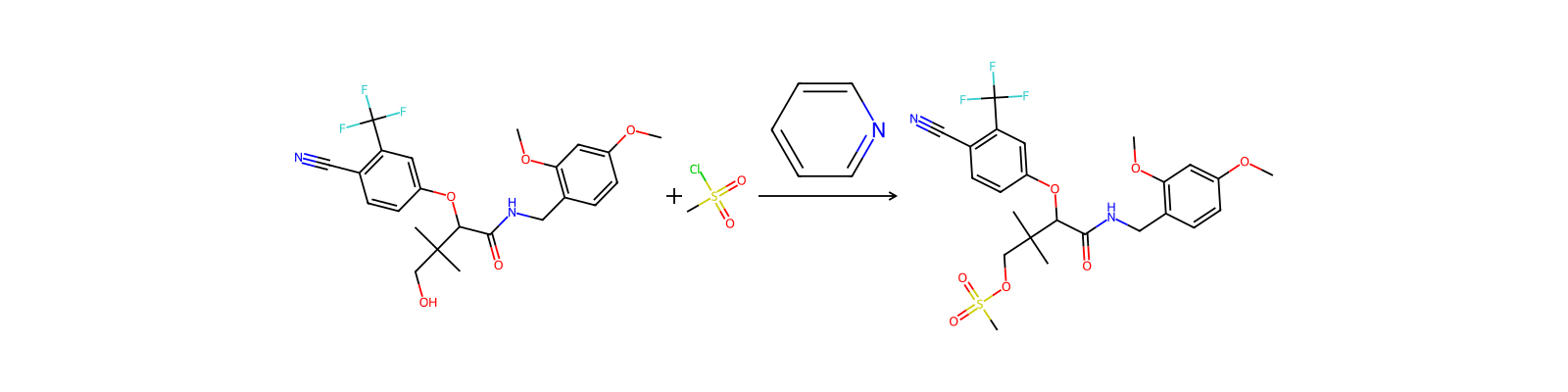
Methanesulfonyl chloride → HCID 87479211, compound
https://huagongshe.com/reaction/1715324
Participants
| Role | Name | HCID | Charge |
|---|
| Reactant | Methanesulfonyl chloride | HCID 31297 | — |
| Reactant | HCID 68503880 | HCID 68503880 | — |
| Solvent | Pyridine | HCID 1049 | — |
| Product | HCID 87479211 | HCID 87479211 | 116.8% |
Reaction Steps
To a clear, colorless solution comprised of 2-(4-cyano-3-trifluoromethyl-phenoxy)-N-(2,4-dimethoxy-benzyl)-4-hydroxy-3,3-dimethyl-butyramide (116.42 g; 250 mmol) in pyridine (160 mL) cooled to 0° C. under a nitrogen atmosphere was added methanesulfonyl chloride (30.2 g; 262 mmol). The mixture turned cloudy yellow with precipitate within 5 minutes of methanesulfonyl chloride addition. The reaction mixture was stirred cold for 1 hour, 20 minutes. The reaction flask was then loaded onto the rotary evaporator over a water bath warmed to 40° C. and the high vacuum was applied. After two hours of rotation, a negligible volume of pyridine had been distilled off and the water bath temperature was raised to 54° C. The pyridine was distilled off as the solution turned to a darker orange color and yielded a dark orange oil. To avoid decomposition, the flask was removed and the contents were partitioned between dichloromethane (1500 mL) and 2N aqueous hydrochloric acid (500 mL.) The unseparated aqueous (top) layer was tested with pH paper to show a pH of 4. The aqueous phase was acidified to pH 0 by the addition of concentrated aqueous hydrochloric acid (10 mL) to the biphasic mixture. The layers were separated and the organic phase was dried over anhydrous magnesium sulfate and vacuum filtered. The vacuum flask containing the clear orange filtrate solution was covered and left at ambient temperature for three days. The solution turned to dark red. Thin layer chromatography analysis of this solution (solvent system: 1:1 v/v hexanes-ethyl acetate) showed the major presence of desired material along with a baseline (Rf=0) species and two higher Rf species. The solution was concentrated in vacuo, keeping the water bath temperature at 35° C., to obtain 159 g of a red foam; 1H-NMR (400 MHz; CDCl3) δ 7.59 (d, 1H, J=2.1 Hz), 7.23 (d, 1H, J=2.5 Hz), 7.05 (d, 1H, J=2.1 Hz), 6.93 (dd, 1H, J=2.2, 0.7 Hz), 6.50 (t, 1H, J=1.5 Hz), 6.36 (dd, 1H, J=2.1, 0.6 Hz), 6.26 (d, 1H, J=0.6 Hz), 5.28 (s, 1H), 4.45 (s, 1H), 4.36-4.24 (m, 2H), 4.11 (dd, 2H, J=6.7, 2.4 Hz), 3.77 (s, 3H), 3.57 (s, 3H), 2.99 (s, 3H), 1.13 (s, 3H), 1.12 (s, 3H); 19F-NMR (376 MHz; CDCl3) δ −62.69 (s, 3F).
Provenance & Evidence
| DOI | 10.6084/m9.figshare.5104873.v1 |
|---|
| Patent number | US07799823B2 |
|---|
| Source dataset | uspto-grants-2010_09 |
|---|
| ORD ID | ord-4137c166193746e6b682fd3401c3f3dc |
|---|
| Source note | uspto-grants-2010_09 |
|---|