Chlorine → 1-Chloro-2,4-difluorobenzene
Reaction equation

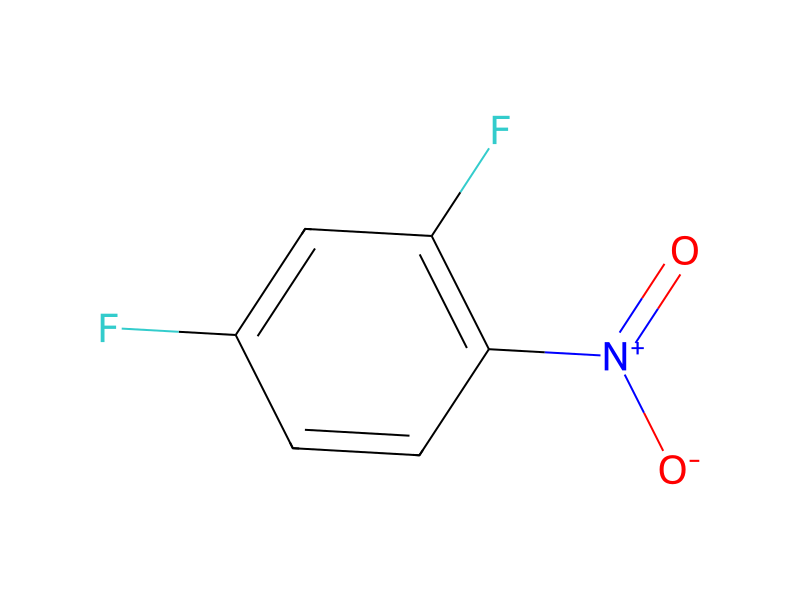
ClCl.[F-].[Cl:4][C:5]1[C:6]([F:12])=[C:7](F)[CH:8]=[CH:9][CH:10]=1.[F:13]C1C=C(F)C=CC=1[N+]([O-])=O>>[F:12][C:6]1[CH:7]=[C:8]([F:13])[CH:9]=[CH:10][C:5]=1[Cl:4]Participants




Procedure
The chlorine gas which is used is employed in anhydrous form. The reaction of the m-difluoronitro-aromatic compounds with the chlorine must be carried out in the absence of Lewis acids or other chlorinating catalysts. The required temperatures are within the range from 80° to 250° C. preferably 100° to 200° C. The reaction can be carried out in the presence or absence of a fluoride-capturing agent. The necessary chlorodifluorobenzene compound (starting compound) can, for example, be prepared as follows: 1800 g (11.3 mol) of 2,4-difluoronitrobenzene (anhydrous and free of Lewis acids) are initially introduced into a 2 l four-neck flask having a stirrer, gas-entry tube and distillation bridge. The reaction solution is brought to 160° C. A stream of chlorine of 4-6 l/h is then passed through the solution at this temperature. After 1-2 h, brown gases are formed which are absorbed in dilute sodium hydroxide solution. After 28 h, the entry of gas is stopped and the reaction solution is distilled (head temperature 127° C). 675.8 g of 2,4-difluorochlorobenzene are obtained, corresponding to a yield of 91%, based on reacted 2,4-difluoronitrobenzene.
Workup
- customare within the range from 80° to 250° C. preferably 100° to 200° C
- customThe reaction
- distillationdistillation bridge
- customis brought to 160° C
- custombrown gases are formed which
- customare absorbed in dilute sodium hydroxide solution
- waitAfter 28 h
- distillationthe reaction solution is distilled (head temperature 127° C)
Sources & evidence
- ORD record
- ord-cc412f2d0cac45f8a287cb7600fff281
- Source dataset
- uspto-grants-1996_04
- Patent number
- US05504264
Reaction notes
Loading…