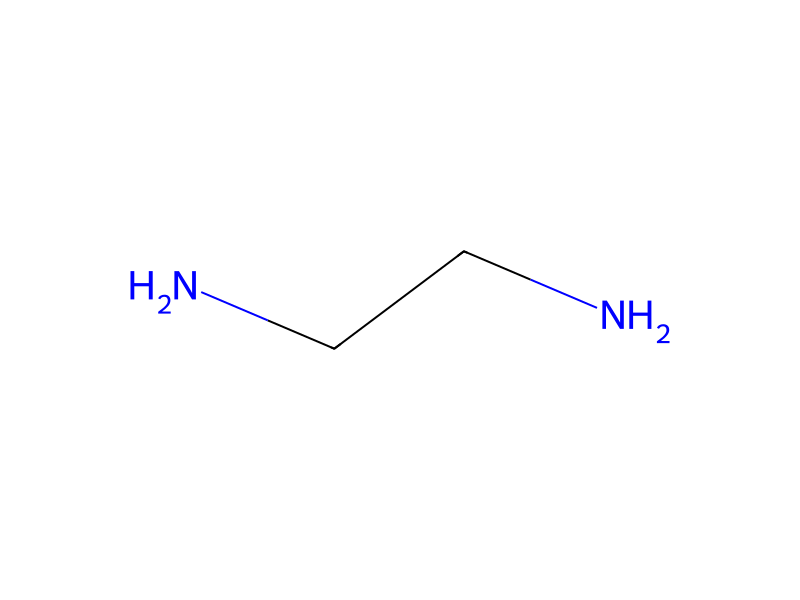
Ethylenediamine → Propanenitrile, 3,3',3'',3'''-(1,2-ethanediyldinitrilo)tetrakis-
Reaction equation

[CH2:1]([NH2:4])[CH2:2][NH2:3].[C:5](#[N:8])[CH:6]=[CH2:7]>>[C:5]([CH2:6][CH2:7][N:3]([CH2:7][CH2:6][C:5]#[N:8])[CH2:2][CH2:1][N:4]([CH2:7][CH2:6][C:5]#[N:8])[CH2:7][CH2:6][C:5]#[N:8])#[N:8]Participants


Conditions
- Temperature
- 100 °C
Procedure
Preparation of CH3 (CH2)6C(O)N CH2 (CHOH)4CH2OH!--(CH2)3 !2--N(CH2)2N-- (CH2)3 -- CH2 (CHOH)4CH2OH!NC(O)(CH2 6CH3 !2One mole of ethylenediamine (60g) is added to 250 g (4.7 moles) acrylonitrile and heated to 100° C. for 2 hrs. Excess acrylonitrile is vacuum stripped to give about 200 g tetrakis (2-cyanoethyl)ethylenediamine. The nitrile is dissolved in 2 l dry methanol saturated with ammonia. It is hydrogenated in the presence of 20 Raney nickel at 100°-120° C. for 3 hrs under 1000-1500 psi hydrogen. The sample is decanted, filtered and stripped under vacuum to give about 200 g tetrakis(3-aminopropyl)ethylenediamine. The whole sample (200 g, 0.7 mole) is added to 5040g 10% aqueous glucose (2.8 mole) and reduced with hydrogen at 1500 psi in the presence of 50 g Raney nickel. The sample is decanted, filtered and stripped to give about 600 g (0.63 mole) tetrakis(glucitylaminopropyl)ethylenediamine. The latter is stripped dry and melted in 200 g propylene glycol. Methyl octanoate (398 g, 2.5 mole) is added along with 0.1 mole 25% sodium methoxide/methanol. The sample is stirred at 85° C. for 3 hrs under 0.5 arm vacuum to give the product.
Sources & evidence
- ORD record
- ord-c14f78d639fa420087fe4056955295d5
- Source dataset
- uspto-grants-1996_04
- Patent number
- US05512699
Reaction notes
Loading…