Potassium Hydroxide → 1-(2-Hydroxyphenyl)-3-(1H-indol-4-yl)prop-2-en-1-one
Reaction equation

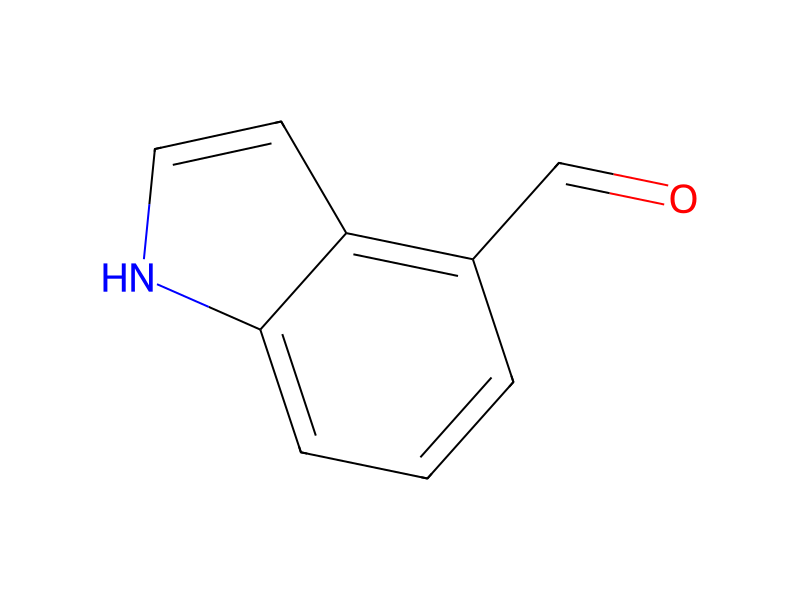
[OH-:1].[K+].[NH:3]1[C:11]2[CH:10]=[CH:9][CH:8]=[C:7]([CH:12]=O)[C:6]=2[CH:5]=[CH:4]1.O[CH2:15][C:16]([C:18]1[CH:23]=[CH:22][CH:21]=[CH:20][CH:19]=1)=[O:17]>[Cl-].C([N+](CC)(CC)CC1C=CC=CC=1)C.C(O)C.O>[NH:3]1[C:11]2[C:6](=[C:7]([CH:12]=[CH:15][C:16]([C:18]3[CH:23]=[CH:22][CH:21]=[CH:20][C:19]=3[OH:1])=[O:17])[CH:8]=[CH:9][CH:10]=2)[CH:5]=[CH:4]1Participants
7
Reactant 3


Product 1

Reagents, catalysts & solvents 3



Procedure
0.5 ml of a 38% potassium hydroxide solution was added with stirring at 30° C. under an inert atmosphere to a mixture of 0.132 g of indol-4-carboaldehyde, 0.1 ml of 2-hydroxy-acetophenone and 0.189 g of triethylbenzyl ammonium chloride in 2 ml of ethanol and after stirring at 30° for 23 hours, the mixture was diluted with water and extracted with ethyl acetate. The organic phase was washed with water, dried over a deshydrant and evaporated to dryness. The residue was chromatographed over silica and eluted with methylene chloride to obtain 159 mg of 3-(1H-indol-4-yl)-1-(2-hydroxy-phenyl)-2-propen-1-one melting at ≃164° C.
Workup
- extractionextracted with ethyl acetate
- washThe organic phase was washed with water
- customdried over a deshydrant
- customevaporated to dryness
- customThe residue was chromatographed over silica
- washeluted with methylene chloride
Sources & evidence
- ORD record
- ord-cf5d62f9628f4d9aba32d09948b8af86
- Source dataset
- uspto-grants-1989_08
- Patent number
- US04853408
Reaction notes
Loading…