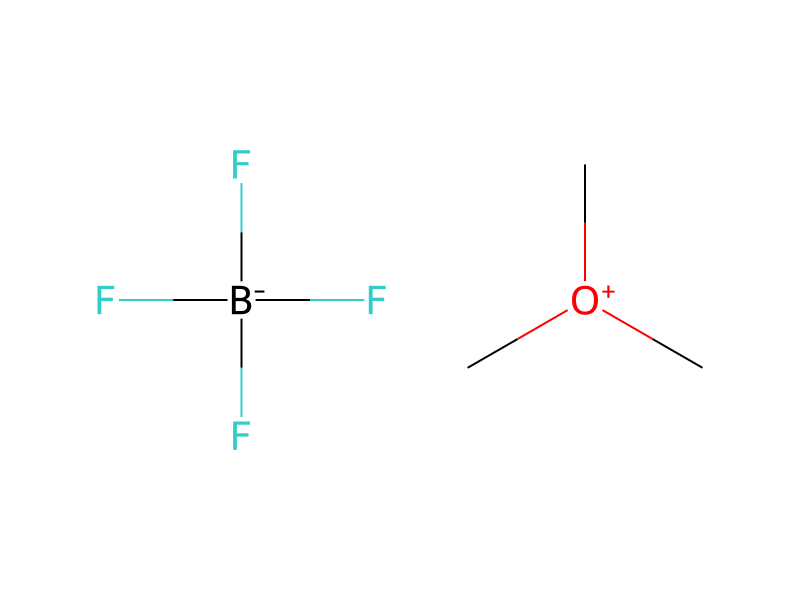
Oxonium, trimethyl-, tetrafluoroborate(1-) (1:1) → 4,6-Dichloro-1,2-dimethylquinolinium tetrafluoroborate
Reaction equation

[Cl:1][C:2]1[C:11]2[C:6](=[CH:7][CH:8]=[C:9]([Cl:12])[CH:10]=2)[N:5]=[C:4]([CH3:13])[CH:3]=1.[F:14][B-:15]([F:18])([F:17])[F:16].[CH3:19][O+](C)C>>[F:14][B-:15]([F:18])([F:17])[F:16].[Cl:1][C:2]1[C:11]2[C:6](=[CH:7][CH:8]=[C:9]([Cl:12])[CH:10]=2)[N+:5]([CH3:19])=[C:4]([CH3:13])[CH:3]=1Participants
3


Procedure
The starting material may be prepared as follows. Powered 4,6-dichloro-2-methylquinoline (254 mg.) was added to a stirred solution of trimethyloxonium tetrafluoroborate (177 mg.) in acetontrile (1 ml.), and stirring was continued overnight. The solvent was evaporated and the residue was triturated with ether to give 4,6-dichloro-1,2-dimethylquinolinium tetrafluoroborate (296 mg.). N.m.r. in solvent A:-3.07(s, 3H); 4.44(s, 3H9; 7.9-8.8(complex, 4H).
Workup
- customThe starting material may be prepared
- customThe solvent was evaporated
- customthe residue was triturated with ether
Sources & evidence
- ORD record
- ord-88154653bb1840dc97e01f5ab0d7164d
- Source dataset
- uspto-grants-1989_08
- Patent number
- US04855420
Reaction notes
Loading…