Water → (1-Phenylcyclopentyl)methanol
Reaction equation

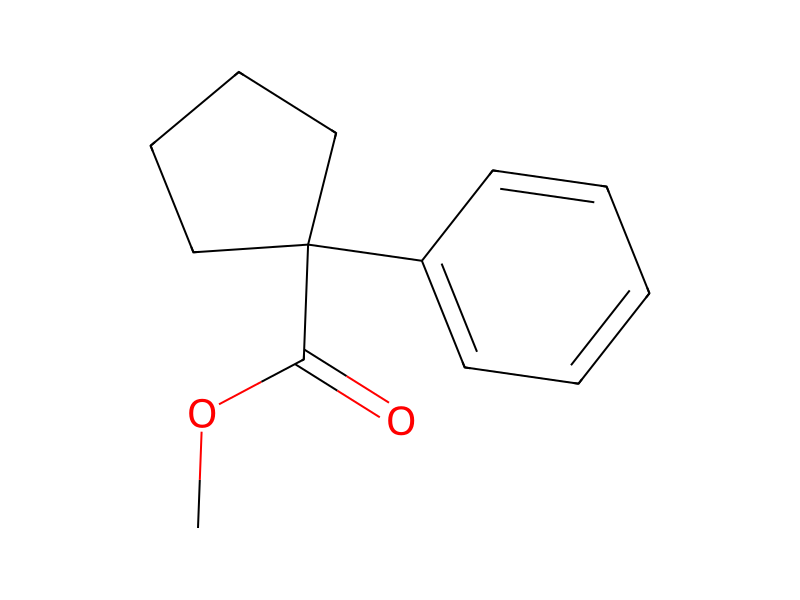
C[O:2][C:3]([C:5]1([C:10]2[CH:15]=[CH:14][CH:13]=[CH:12][CH:11]=2)[CH2:9][CH2:8][CH2:7][CH2:6]1)=O.[H-].[H-].[H-].[H-].[Li+].[Al+3].O.[OH-].[Na+]>C1COCC1>[C:10]1([C:5]2([CH2:3][OH:2])[CH2:9][CH2:8][CH2:7][CH2:6]2)[CH:15]=[CH:14][CH:13]=[CH:12][CH:11]=1Participants





Procedure
A solution of the product of Step A (3.00 g, 14.71 mmol) in 10 mL THF was added dropwise to a suspension of LiAlH4 (1.25 g, 33.09 mmol) in 25 mL dry THF. The reaction mixture was stirred at reflux for three hours. The excess LiAlH4 was destroyed following the method described in Reagents for Organic Synthesis, Vol 1 [1967] p. 584 (J. Wiley & Son), by quenching the cooled reaction mixture with the addition of 1.25 mL water, followed by the addition of 1.25 mL 154 sodium hydroxide (w/v), followed by the addition of 3.75 mL water. The resulting aluminum salts were separated by filtration and washed with water (5×1 mL). The product was extracted with ether (3×25 mL) and dried (Na2SO4). Evaporation of the solvent gave 2.07 g (88%) of 1-phenylcyclopentanemethanol as a white solid, mp 41°-44° C.(the literature value of mp, J. Org. Chem. 27:3434 (1962), is 43°-44° C.).
Workup
- temperatureat reflux for three hours
- customThe excess LiAlH4 was destroyed
- customdescribed in Reagents for Organic Synthesis, Vol 1 [1967] p
- custom584 (J. Wiley & Son), by quenching
- customthe cooled reaction mixture
- customThe resulting aluminum salts were separated by filtration
- washwashed with water (5×1 mL)
- extractionThe product was extracted with ether (3×25 mL)
- dry with materialdried (Na2SO4)
- customEvaporation of the solvent
Sources & evidence
- ORD record
- ord-0812b3dee8844785bf56f4235189fd74
- Source dataset
- uspto-grants-1994_07
- Patent number
- US05331010
Reaction notes
Loading…