1,1-Dichloroethane → Styrene
Reaction equation

[CH2:1]=[CH:2][C:3]1[CH:8]=[CH:7][CH:6]=[CH:5][CH:4]=1.[CH:9]([C:11]1[CH:16]=[CH:15][CH:14]=[CH:13][C:12]=1[CH:17]=[CH2:18])=[CH2:10].Cl[CH:20](Cl)[CH3:21]>>[CH2:1]=[CH:2][C:3]1[CH:8]=[CH:7][CH:6]=[CH:5][CH:4]=1.[CH:9]([C:11]1[CH:16]=[CH:15][CH:14]=[CH:13][C:12]=1[CH:17]=[CH2:18])=[CH2:10].[CH3:10][CH2:9][CH2:11][CH2:16][CH2:15][CH2:14][CH2:13][CH2:12][CH2:17][CH:20]([CH3:21])[CH3:1]Participants


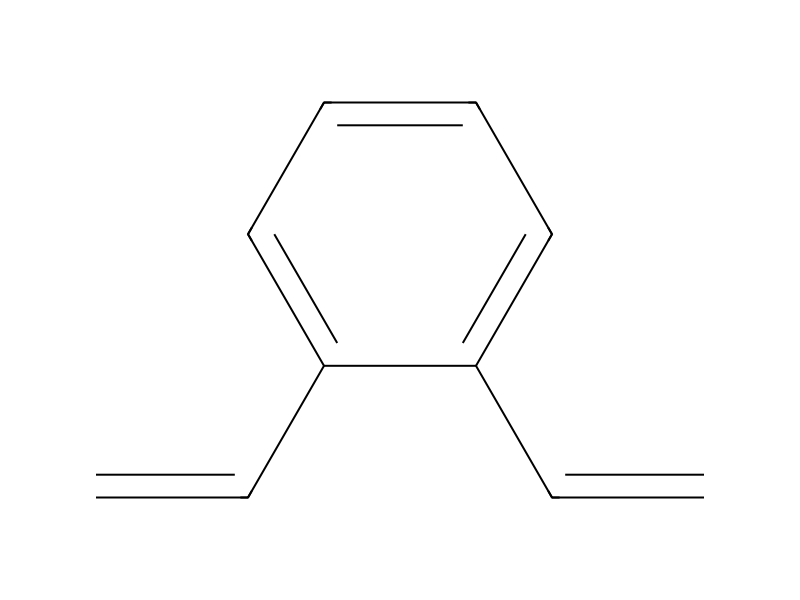

Procedure
436 g of the succinic acid ester prepared in this manner are dissolved in 1200 g of dichloroethane. 160 g of a macroporous styrene bead polymer crosslinked with 8 % of divinyl benzene (obtained by bead polymerisation of styrene and divinyl benzene in the presence of 60 % by weight of isododecane based on the sum total of monomers) are swollen in this solution over a period of 30 minutes at 60° C, 100 g of concentrated sulphuric acid are then added dropwise with stirring over a period of 3 hours. After stirring the reaction mixture for 20 hours at reflux temperature, the reaction product is separated off. The product is freed form adherent dichloroethane by suspending it in 10 % aqueous ammonia solution and azeotropic destillation as is described in Example 1. The polymer is then heated for 10 hours to 180° C with 40 % sodium hydroxide solution in an autoclave. After the sodium hydroxide has been washed out, 585 ml of a weakly basic anion exchanger are obtained with an acid binding capacity of 2,72 Val/1 for N/10 hydrochloric acid and a nitrogen content of 10,9 % in the dry material.
Sources & evidence
- ORD record
- ord-d1943ff295404d34b009f12419ad966d
- Source dataset
- uspto-grants-1976_11
- Patent number
- US03989650
Reaction notes
Loading…