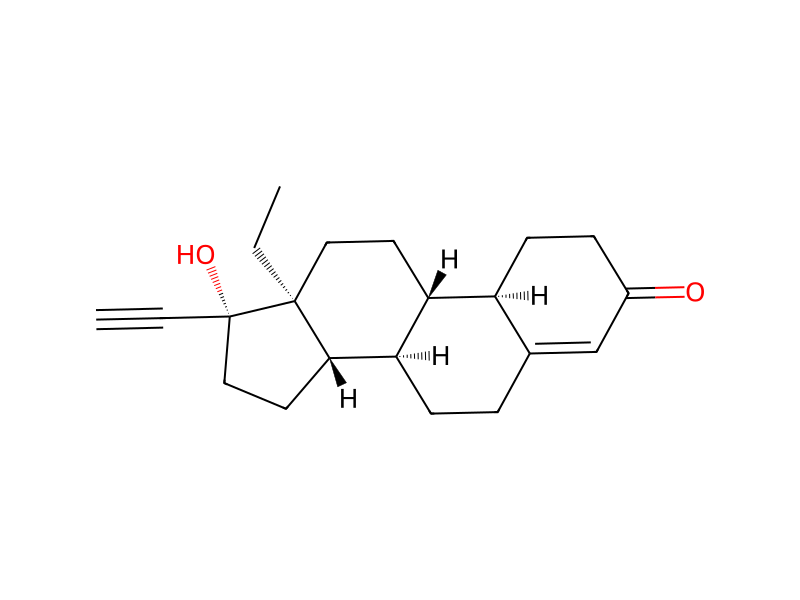
Ammonia → Levonorgestrel
Reaction equation

[CH2:1]([C@:3]12[CH2:11][CH2:10][C@@H:9]3[C@@H:12]4[C:17]([CH2:18][CH2:19][C@H:8]3[C@@H:7]1[CH2:6][CH2:5][C:4]2=[O:21])=[CH:16][C:15](=[O:20])[CH2:14][CH2:13]4)[CH3:2].N.[C-:23]#[C-:24].[K+].[K+]>CC(C)=O>[CH2:1]([C@:3]12[CH2:11][CH2:10][C@@H:9]3[C@@H:12]4[C:17]([CH2:18][CH2:19][C@H:8]3[C@@H:7]1[CH2:6][CH2:5][C@:4]2([C:23]#[CH:24])[OH:21])=[CH:16][C:15](=[O:20])[CH2:14][CH2:13]4)[CH3:2]Participants
5
Reactant 3


Product 1
Reagents, catalysts & solvents 1

Procedure
500 Mg. of 13β-ethyl-gon-4-en-3,17-dione produced in Example 135, was dissolved in 10 ml. of a benzene-ether solvent mixture (1:1) and added to a solution of 50 ml. of liquid ammonia containing 0.1 ml. of acetone and 0.5 g. of potassium acetylide. The reaction mixture was agitated at the ammonia boiling point for 2 hours and then the ammonia was evaporated at room temperature. The organic materials were extracted with ether and then the solvent was evaporated in vacuo. The residue was purified by chromatography over 50 g. of silica gel and on elution with a benzene-ethyl acetate mixture, afforded 13β-ethyl-17α-ethynyl-17-hydroxy-gon-4-en-3-one.
Workup
- customthe ammonia was evaporated at room temperature
- extractionThe organic materials were extracted with ether
- customthe solvent was evaporated in vacuo
- customThe residue was purified by chromatography over 50 g
- washof silica gel and on elution with a benzene-ethyl acetate mixture
Sources & evidence
- ORD record
- ord-8c8a3e6296bf4d65a28e2937f9b62ecd
- Source dataset
- uspto-grants-1976_11
- Patent number
- US03989724
Reaction notes
Loading…