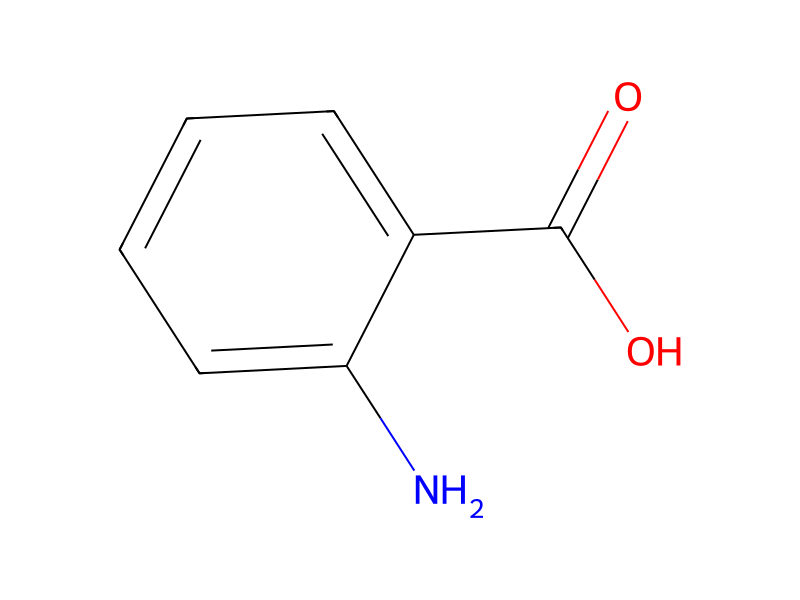
Anthranilic Acid → 1-Phenyl-1H-benzo[d][1,3]oxazine-2,4-dione
Reaction equation

[NH2:1][C:2]1[CH:7]=[CH:6][CH:5]=[CH:4][CH:3]=1.[C:8]([OH:17])(=[O:16])[C:9]1[C:10](=[CH:12][CH:13]=[CH:14][CH:15]=1)N.Cl[C:19](OCC)=[O:20]>>[C:2]1([N:1]2[C:19](=[O:20])[O:17][C:8](=[O:16])[C:9]3=[CH:10][CH:12]=[CH:13][CH:14]=[C:15]23)[CH:7]=[CH:6][CH:5]=[CH:4][CH:3]=1Participants



Procedure
The novel 1,2-diphenylquinolones of formula IV, where m is the interger 0, are prepared by three methods. In a first method the 1,2-diphenylquinolones (IV, m=0) are prepared by reaction of an appropriate N-phenylisatoic anhydride with an appropriate lower-alkyl benzoylacetate, hydrolysis of the resulting 1,2-phenylquinolone-3-carboxylate to the corresponding 3-carboxy compound and pyrolytic elimination of the carboxyl group. In a second method the 1,2-diphenylquinolones (IV, m=0) are prepared by reaction of an appropriate N-phenylisatoic anhydride with sodium methylsulfinylmethide (hereinafter dimsyl sodium), and reaction of the methylsulfinylacetophenone so obtained with an appropriate benzaldehyde. The N-phenylisatoic anhydride is prepared by reacting an appropriate 2-bromo (or chloro)benzoic acid with an appropriate aniline and reacting the resulting anthranilic acid with ethyl chloroformate. These steps are illustrated by the following equations: ##SPC8##
Sources & evidence
- ORD record
- ord-6897c9651fba45ea8ba22d23c8af2c42
- Source dataset
- uspto-grants-1976_11
- Patent number
- US03994902
Reaction notes
Loading…