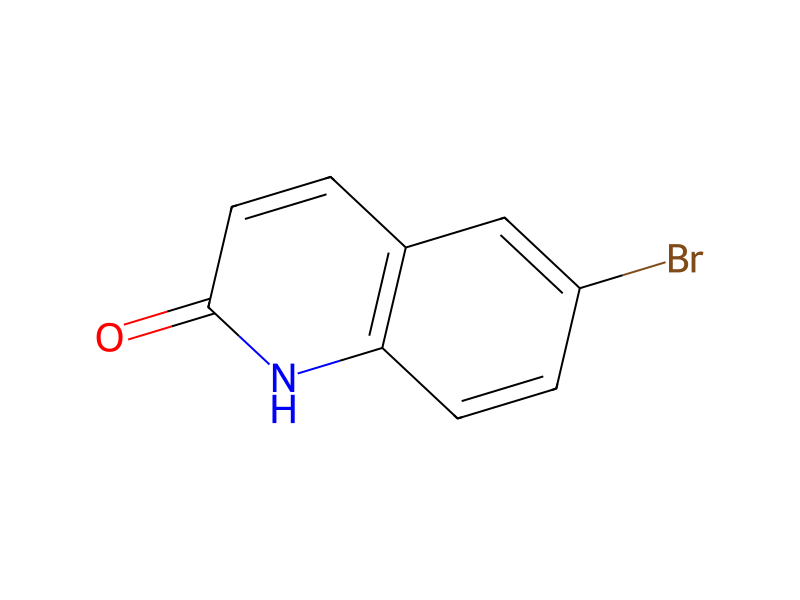
2-Hydroxyquinoline → 6-Bromoquinolin-2(1H)-one
Reaction equation

[NH:1]1[C:11]2[C:6](=[CH:7][CH:8]=[CH:9][CH:10]=2)[CH:5]=[CH:4][C:2]1=[O:3].[Br:12]Br>C(O)(=O)C>[Br:12][C:8]1[CH:7]=[C:6]2[C:11](=[CH:10][CH:9]=1)[NH:1][C:2](=[O:3])[CH:4]=[CH:5]2Participants
4
Reactant 2


Product 1
Reagents, catalysts & solvents 1

Conditions
- Temperature
- 38 °C
Procedure
0.07 Mols (10.16 g) of carbostyril were put into 100 ml acetic acid in a 500 ml round bottom flask fitted with an air stirrer, thermometer and a vented dropping funnel. It was stirred and warmed to 56° C. where the carbostyril was in solution. 0.075 Mols (12.0 g) of bromine were put into 50 ml of acetic acid and added to the reaction over a one hour period. The temperature was held between 56° and 65° C. The reaction was then stirred for 13/4 hr. at 63°-65° C. It was then cooled to 38° C. and the solids filtered off. From this and the filtrate were obtained 7.65 g of 6-bromocarbostyril (product checked by IR). A second fraction of 3.9 g was also obtained which looked to be a mixture of monobromo and dibromocarbostyril.
Workup
- customfitted with an air stirrer
- additionadded to the reaction over a one hour period
- customwas held between 56° and 65° C
- stirringThe reaction was then stirred for 13/4 hr
- customat 63°-65° C
- filtrationthe solids filtered off
Sources & evidence
- ORD record
- ord-6955c9b657c34d1e86e7de3522383b44
- Source dataset
- uspto-grants-1980_12
- Patent number
- US04236912
Reaction notes
Loading…