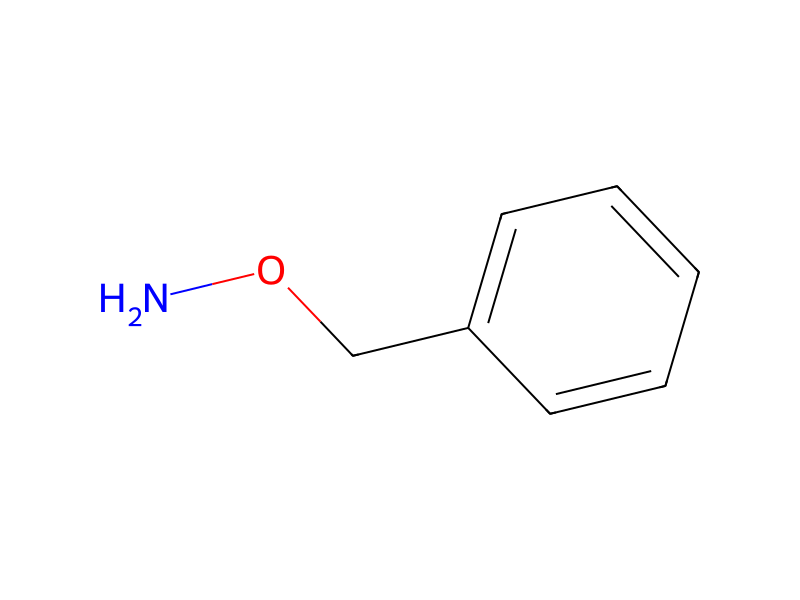
O-Benzylhydroxylamine → 2,4-Diamino-6-phenylmethoxyimino-5,6,7,8-tetrahydroquinazoline
Reaction equation

[C:1]1([CH2:7][O:8][NH2:9])[CH:6]=[CH:5][CH:4]=[CH:3][CH:2]=1.CC(C([NH:16][C:17]1[N:26]=[C:25]([NH:27]C(C(C)(C)C)=O)[C:24]2[CH2:23][C:22](=O)[CH2:21][CH2:20][C:19]=2[N:18]=1)=O)(C)C>>[NH2:16][C:17]1[N:26]=[C:25]([NH2:27])[C:24]2[CH2:23][C:22](=[N:9][O:8][CH2:7][C:1]3[CH:6]=[CH:5][CH:4]=[CH:3][CH:2]=3)[CH2:21][CH2:20][C:19]=2[N:18]=1Participants


Procedure
When the bridging group n is =NOCH2 --, an appropriately substituted or unsubstituted phenylmethyl chloride, for example, 3-trifluoromethylphenylmethyl chloride, is reacted under basic conditions with N-hydroxyphthalimide in dimethyl sulfoxide, yielding the corresponding N-(phenylmethoxy)phthalimide. The so-prepared phthalimide is in turn reacted with hydrazine monohydrate in ethanol, affording an O-(phenylmethyl)hydroxylamine, for example, O-(3-trifluorophenylmethyl)hydroxylamine. The O-(phenylmethyl)hydroxylamine is then reacted with 2,4-di[(1,1 -dimethylethyl)carbonylamino]-5,6,7,8-tetrahydro-6-quinazolinone, as described above, yielding the targeted 2,4-diamino-6-phenylmethoxyimino-5,6,7,8-tetrahydroquinazoline. Example 13 provides a detailed description of how this reaction is conducted.
Sources & evidence
- ORD record
- ord-706b214c9be34cfd9994e1c995099dc7
- Source dataset
- uspto-grants-1996_07
- Patent number
- US05536725
Reaction notes
Loading…