alpha,alpha-Diphenyl-4-pyridinemethanol → Azacyclonol
Reaction equation

[N:1]1[CH:6]=[CH:5][C:4]([C:7]([C:15]2[CH:20]=[CH:19][CH:18]=[CH:17][CH:16]=2)([C:9]2[CH:14]=[CH:13][CH:12]=[CH:11][CH:10]=2)[OH:8])=[CH:3][CH:2]=1.[H][H]>[Pt]=O.C(O)(=O)C>[C:9]1([C:7]([C:15]2[CH:20]=[CH:19][CH:18]=[CH:17][CH:16]=2)([CH:4]2[CH2:5][CH2:6][NH:1][CH2:2][CH2:3]2)[OH:8])[CH:10]=[CH:11][CH:12]=[CH:13][CH:14]=1Participants
Reactant 2
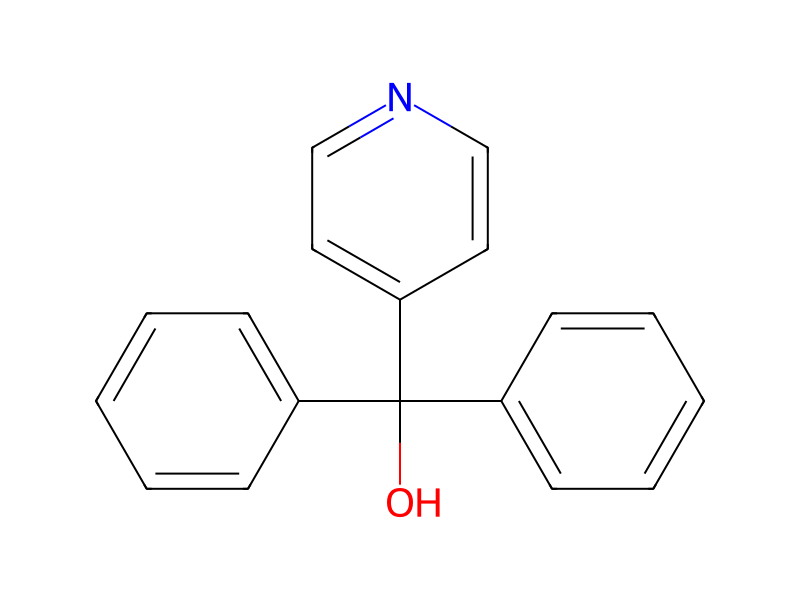

Product 1

Reagents, catalysts & solvents 2


Conditions
- Temperature
- 75 °C
Procedure
A 1.4 liter hydrogenation shaker bomb was charged with 4-pyridyl diphenyl carbinol (46.5 grams, 0.18 mole), platinum oxide (2.0 grams) and glacial acetic acid (325 ml). The bomb was sealed, pressurized with hydrogen to 200 psi, and heated with shaking to 75° C. for 3 hours. The bomb was then cooled and the contents filtered and evaporated to remove the acetic acid. After evaporation, the material was neutralized with aqueous sodium hydroxide (120 grams of 50% NaOH and 330 ml water). The solid material was thereafter filtered and washed with cold water to give on drying diphenyl 4-piperidyl carbinol (Azacyclonol) (43.2 grams, 91% yield). To an ethanolic solution of Azacyclonol was added hydrogen chloride, thus giving Azacyclonol hydrochloride salt.
Workup
- customThe bomb was sealed
- temperatureheated
- temperatureThe bomb was then cooled
- filtrationthe contents filtered
- customevaporated
- customto remove the acetic acid
- customAfter evaporation
- filtrationThe solid material was thereafter filtered
- washwashed with cold water
- customto give
Sources & evidence
- ORD record
- ord-6a3c01426bda483384db7a617796f857
- Source dataset
- uspto-grants-1996_07
- Patent number
- US05541331
Reaction notes
Loading…