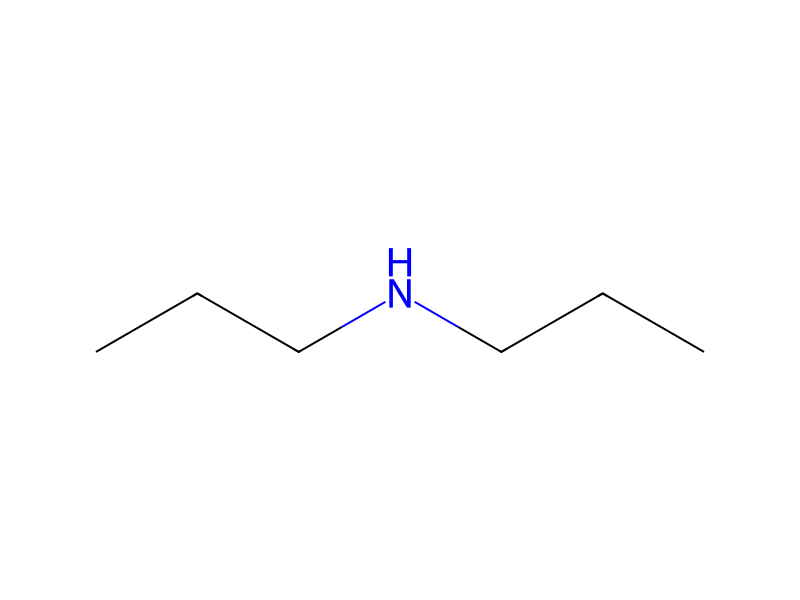
Dipropylamine → HCID 21842252, compound
Reaction equation

[CH2:1]([NH:4][C:5]([C:7]1[N:8]=[CH:9][N:10]2[C:16]3[CH:17]=[CH:18][CH:19]=[C:20]([Cl:21])[C:15]=3[C:14](=[O:22])[N:13]([CH3:23])[CH2:12][C:11]=12)=[O:6])[C:2]#[CH:3].IN1C(=O)CCC1=O.[CH2:32]([NH:35][CH2:36][CH2:37][CH3:38])[CH2:33][CH3:34]>C(O)(=O)C>[Cl:21][C:20]1[C:15]2[C:14](=[O:22])[N:13]([CH3:23])[CH2:12][C:11]3[N:10]([CH:9]=[N:8][C:7]=3[C:5]3[O:6][C:2]([CH2:3][N:35]([CH2:36][CH2:37][CH3:38])[CH2:32][CH2:33][CH3:34])=[CH:1][N:4]=3)[C:16]=2[CH:17]=[CH:18][CH:19]=1Participants
Reactant 3


Product 1

Reagents, catalysts & solvents 1

Procedure
A solution of 3.28 g of (0.010 mol) of 7-chloro-5-methyl-6-oxo-5,6-dihydro-4H-imidazo[1,5-a][1,4]benzodiazepine-3-carboxylic acid prop-2-ynylamide in 60 ml of acetic acid was treated with 3.36 g (0.015 mol) of N-iodosuccinimide while gassing with argon. After stirring at room temperature for 67 hrs. the dark suspension obtained was completely freed from the solvents and dried azeotropically several times with toluene. The dark solid residue was dissolved in 100 ml of THF, treated with 13.7 ml (0.10 mol) of dipropylamine and stirred at room temperature for 3 hrs. The brown-orange suspension obtained was completely freed from the solvents, the residue was partitioned between ethyl acetate and 1N aqueous hydrochloric acid and extracted. The aqueous-acidic phase was made basic and extracted with ethyl acetate. The organic phase was concentrated and the beige-brownish product was chromatographed twice: firstly over basic Alox (grade III) with dichloromethane/ethyl acetate 4:1 as the eluent, then over silica gel with dichloromethane/methanol 98:2 as the eluent. There were obtained 1.2 g (28%) of 7-chloro-3-(5-dipropylaminomethyl-oxazol-2-yl)-5-methyl-5,6-dihydro-4H-imidazo[1,5-a][1,4]benzodiazepin-6-one as a yellow viscous oil.
Workup
- customthe dark suspension obtained
- dry with materialdried azeotropically several times with toluene
- dissolutionThe dark solid residue was dissolved in 100 ml of THF
- stirringstirred at room temperature for 3 hrs
- customThe brown-orange suspension obtained
- customthe residue was partitioned between ethyl acetate and 1N aqueous hydrochloric acid
- extractionextracted
- extractionextracted with ethyl acetate
- concentrationThe organic phase was concentrated
- customthe beige-brownish product was chromatographed twice
Sources & evidence
- ORD record
- ord-9147a0ec501f44c89d1423219111392e
- Source dataset
- uspto-grants-1999_10
- Patent number
- US05962450
Reaction notes
Loading…