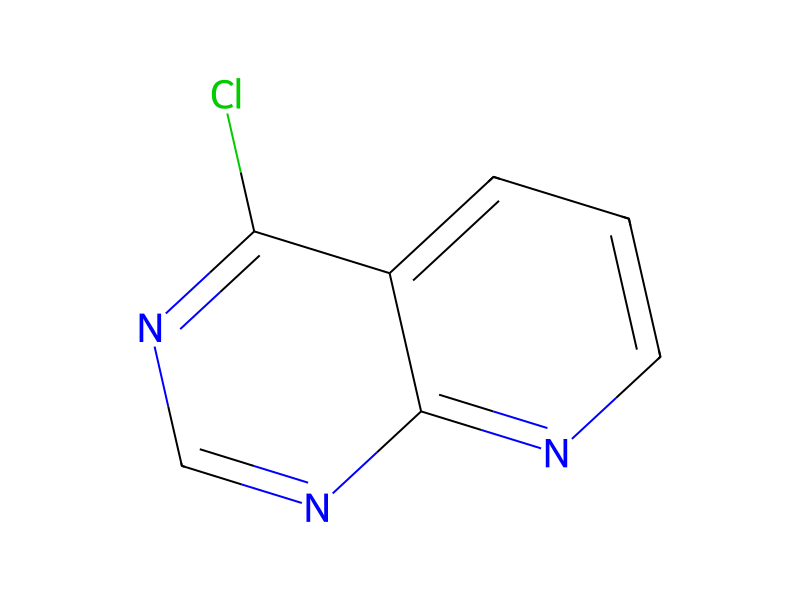
4-Chloropyrido[2,3-d]pyrimidine → HCID 54255407, compound
Reaction equation

Cl[C:2]1[C:3]2[CH:11]=[CH:10][CH:9]=[N:8][C:4]=2[N:5]=[CH:6][N:7]=1.[CH2:12]1[C:20]2[C:15](=[CH:16][C:17]([CH:21]3[C:26](=[O:27])[NH:25][C:24](=[O:28])[NH:23][C:22]3=[O:29])=[CH:18][CH:19]=2)[CH2:14][CH2:13]1>>[CH2:12]1[C:20]2[C:15](=[CH:16][C:17]([C:21]3([C:2]4[C:3]5[CH:11]=[CH:10][CH:9]=[N:8][C:4]=5[N:5]=[CH:6][N:7]=4)[C:22](=[O:29])[NH:23][C:24](=[O:28])[NH:25][C:26]3=[O:27])=[CH:18][CH:19]=2)[CH2:14][CH2:13]1Participants
3


Conditions
- Temperature
- 130 °C
Procedure
A slurry of 4-chloro-pyrido[2,3-d]pyrimidine (1.656 g, 10 mM) and 5-(5-indanyl) barbituric acid (2.443 g, 10 mM) is stirred in an oil bath. The temperature is raised to 130° C. in a period of 15 min. Then the temperature is further increased from 130° C. to 170° C. During this period apparently a reaction occurs since the slurry solidifies. The resulting solid is maintained for further 10 min at about 170° C. Then the reaction mixture is cooled, triturated with sodium bicarbonate solution and hexane. The solid is filtered off, washed with water and dried under vacuum. The raw product is submitted to the next step without further purification.
Workup
- temperatureThen the temperature is further increased from 130° C. to 170° C
- waitDuring this period apparently a reaction occurs since the slurry
- temperatureThe resulting solid is maintained for further 10 min at about 170° C
- temperatureThen the reaction mixture is cooled
- customtriturated with sodium bicarbonate solution and hexane
- filtrationThe solid is filtered off
- washwashed with water
- customdried under vacuum
- customThe raw product is submitted to the next step without further purification
Sources & evidence
- ORD record
- ord-6158bce6e9b34fcd8e325320423e1405
- Source dataset
- uspto-grants-1999_10
- Patent number
- US05965563
Reaction notes
Loading…